
28 Practical Use Cases for Nano-Banana
Discover 28 innovative use cases for Nano-banana, the groundbreaking AI tool revolutionizing visual content creation. Learn how this multimodal AI system enhances workflows in gaming, media, and marketing by maintaining visual consistency, enabling iterative creative development, and producing high-quality assets. Explore its advanced capabilities, including character pose modifications, scene compositions, and style transformations, to elevate your creative projects.
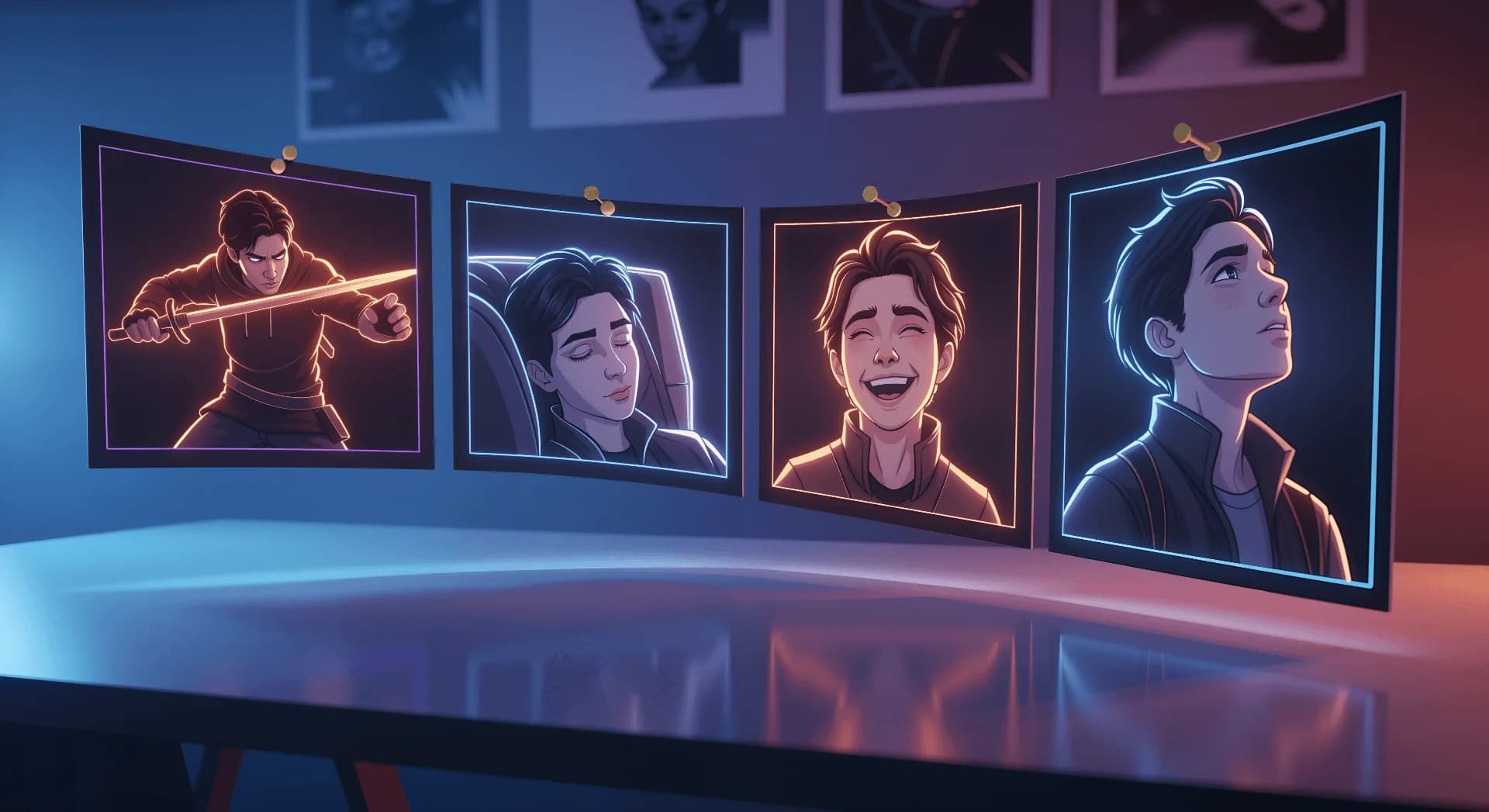
If you've been following the AI content creation landscape recently, you've likely heard about an innovative tool making waves: Gemini 2.5 aka Nano-banana. This breakthrough model is setting new standards for AI-generated visual content.
Drawing from industry experts and creative professionals, we’ve compiled 28 compelling use cases for Nano-banana that showcase its versatility across gaming, media, marketing, and everyday content creation workflows.
What Makes Nano-banana a Game-Changer for Creative Professionals
Unlike conventional text-to-image generation tools, Nano-banana operates as a true multimodal AI system, with a deep understanding of both visual and textual inputs.
Instead of producing single static outputs, it enables iterative creative development through conversation, making it feel more like collaborating with a skilled creative partner than using a typical AI tool.
Nano-banana represents a significant advancement in Scenario's suite of AI content generation tools, renowned for maintaining visual consistency, enabling complex multi-step edits, and processing sophisticated transformations through natural language instructions.
The Breakthrough Innovation: Visual Consistency
A persistent challenge with AI image tools has been maintaining consistent visual elements across iterations. Make one adjustment, and suddenly characters look different or design elements shift unexpectedly.
Nano-banana effectively solves this problem:
- Character features remain consistent throughout editing sessions
- Brand elements maintain their integrity across multiple generations
- Design proportions stay balanced even with significant modifications
Advanced Capabilities Beyond Basic Image Generation
- Multi-asset integration → Combine multiple visual elements into cohesive, production-ready compositions
- Style transfer and adaptation → Apply artistic styles, textures, or visual languages across different assets
- Conversational creative workflow → Edit and refine through natural dialogue rather than technical parameters
- Production-grade output quality → Generate assets ready for games, marketing campaigns, and media projects
- Visual enhancement and restoration → Improve existing assets with intelligent upscaling and refinement
28 Practical Use Cases for Nano-Banana
Based on industry research and professional feedback, here are the 28 practical use cases of Nano-banana's impact across creative industries, all created via Scenario's edit-with-prompts interface and fully reproducible:
1. Character Pose and Action Modification
Modify character body language and positioning while intelligently removing or adding objects to create entirely different emotional contexts and narrative meanings. This technique preserves character identity, facial features, and artistic style while allowing complete repositioning of limbs, torso orientation, and hand gestures.
Use Case: A warrior character's aggressive stance is transformed into a confident, arms-crossed posture.
Prompt: "Remove the weapon and pose her with her arms crossed over her chest"
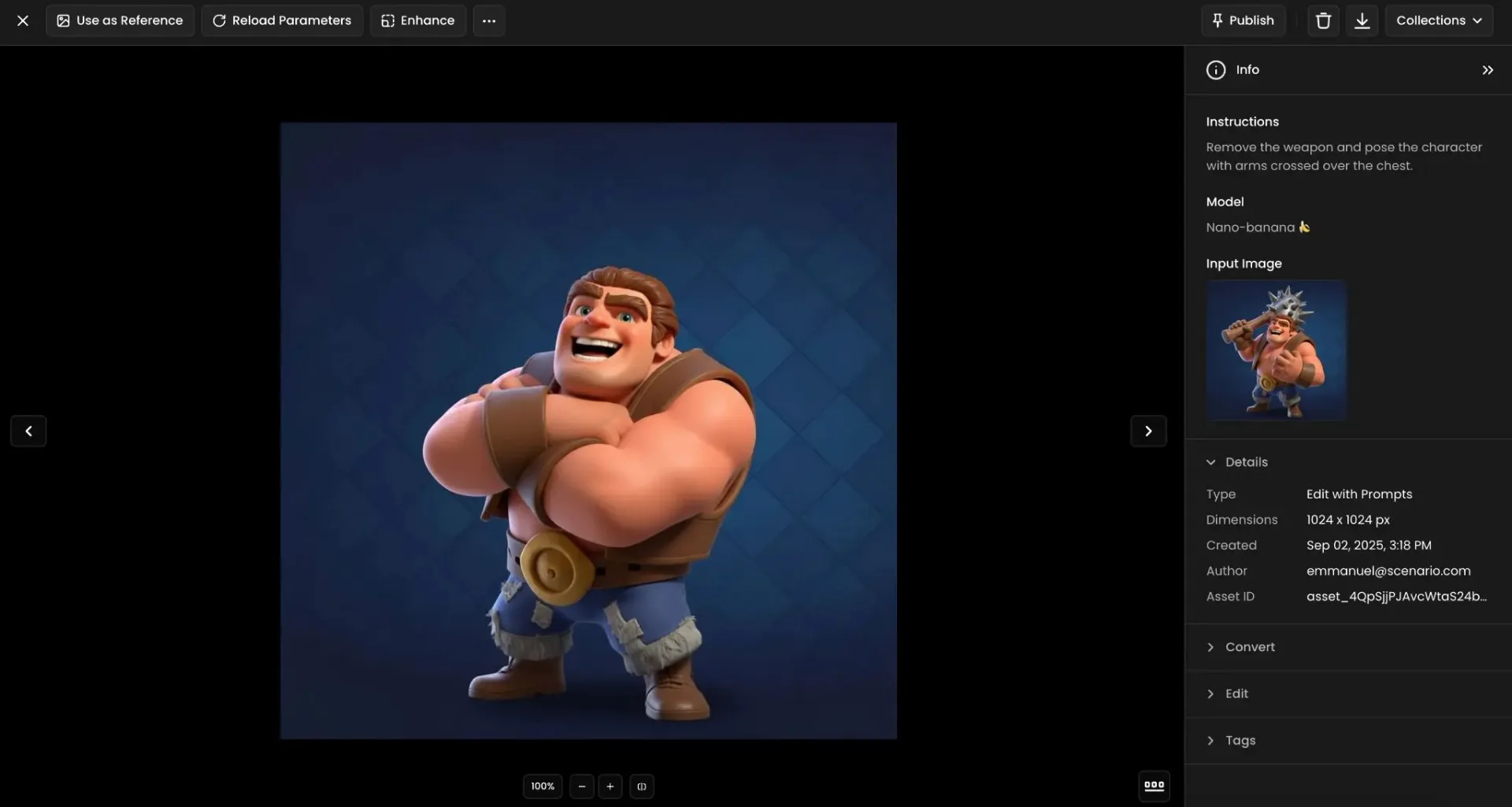
Cartoon warrior with crossed arms in confident stance.
2. Character Proportion Enhancement
Alter character anatomy and body proportions to fit different archetypes, from realistic human proportions to stylized heroic builds or cartoon exaggerations. The AI maintains facial features, clothing details, and overall character design while scaling specific body parts to achieve the desired silhouette and visual impact.
Use Case: A character is given a more heroic build with broader shoulders, larger hands and feet, and increased height.
Prompt: "Make her more heroic (broader shoulders, slightly larger hands and feet, increased height relative to head size)"
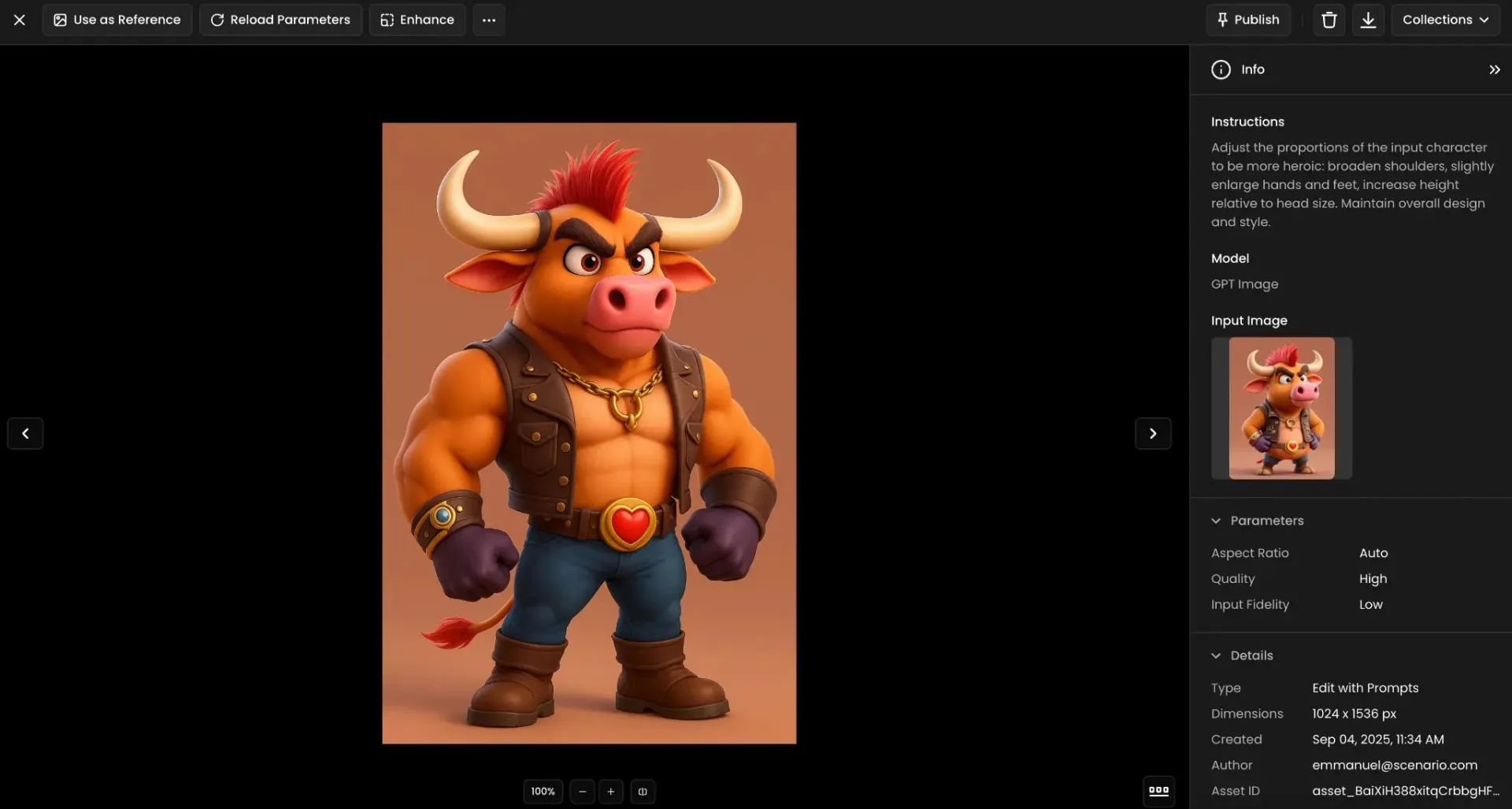
Muscular bull character in leather vest flexing.
3. Photorealistic to Isometric Style Conversion
Transform real-world photography into stylized game-ready assets that match specific artistic directions and technical requirements. This process analyzes reference art styles and applies consistent color palettes, geometric simplification, and perspective adjustments to create cohesive game environments from photographic sources.
Use Case: A photograph of a monument is converted into a 3D isometric cartoon-style tile, matching the style of other reference images.
Prompt: "Turn this photograph of a monument into an isometric tile in the 3D cartoon style of the five other 3D rendered images"
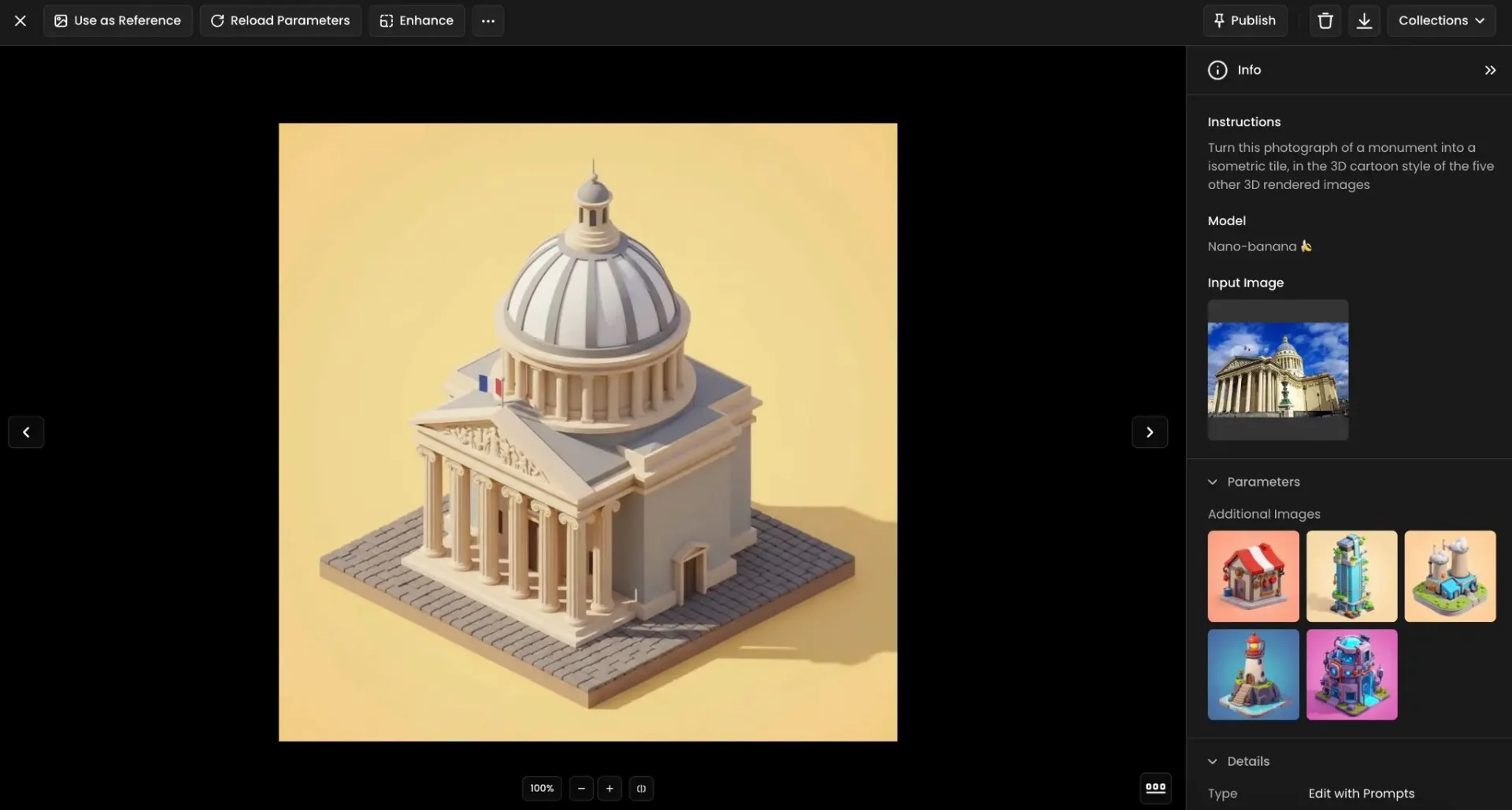
Isometric neoclassical building with green dome.
4. Multi-Character Scene Composition
Combine individual character renders into cohesive group compositions with unified lighting, consistent perspective, and environmental integration. The AI handles scale relationships, shadow casting, atmospheric effects, and character interactions to create believable scenes that look naturally composed rather than artificially assembled.
Use Case: Three individual character images are composed into a unified scene, showing them ready for battle in a castle courtyard.
Prompt: "Pose the three characters together in a castle courtyard, standing as if united and ready to fight"
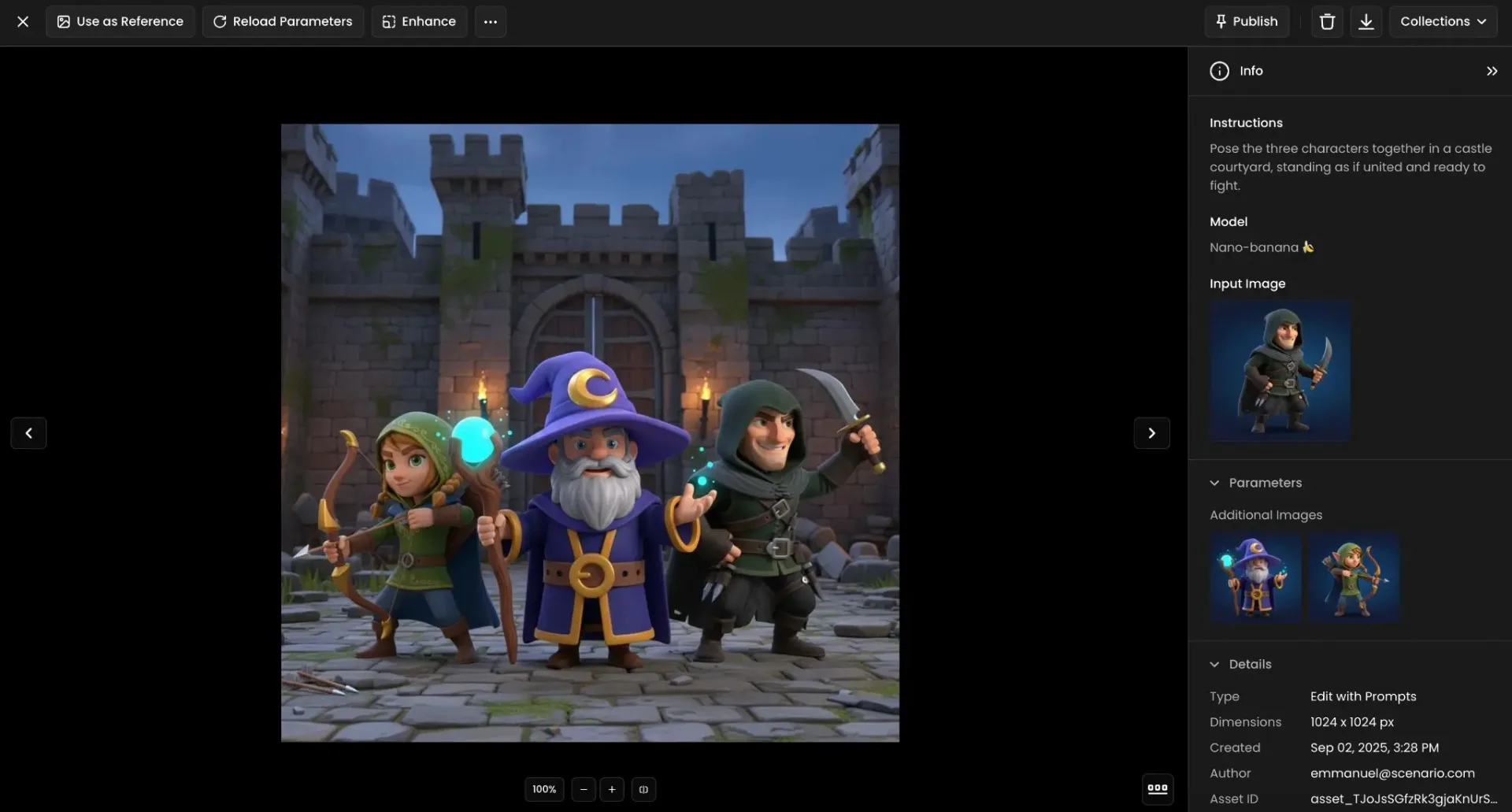
Three fantasy heroes united in castle courtyard.
5. Character Creation from Style References
Generate completely new characters by analyzing the artistic DNA of existing character sets, extracting style elements like proportions, color schemes, shading techniques, and design motifs. This ensures new additions feel like natural extensions of established character rosters rather than foreign elements that break visual consistency.
Use Case: A new mage character is generated in the same artistic style as a set of six reference images.
Prompt: "Create a new mage character inspired by the six images, designed in the same style, set against a blue background"
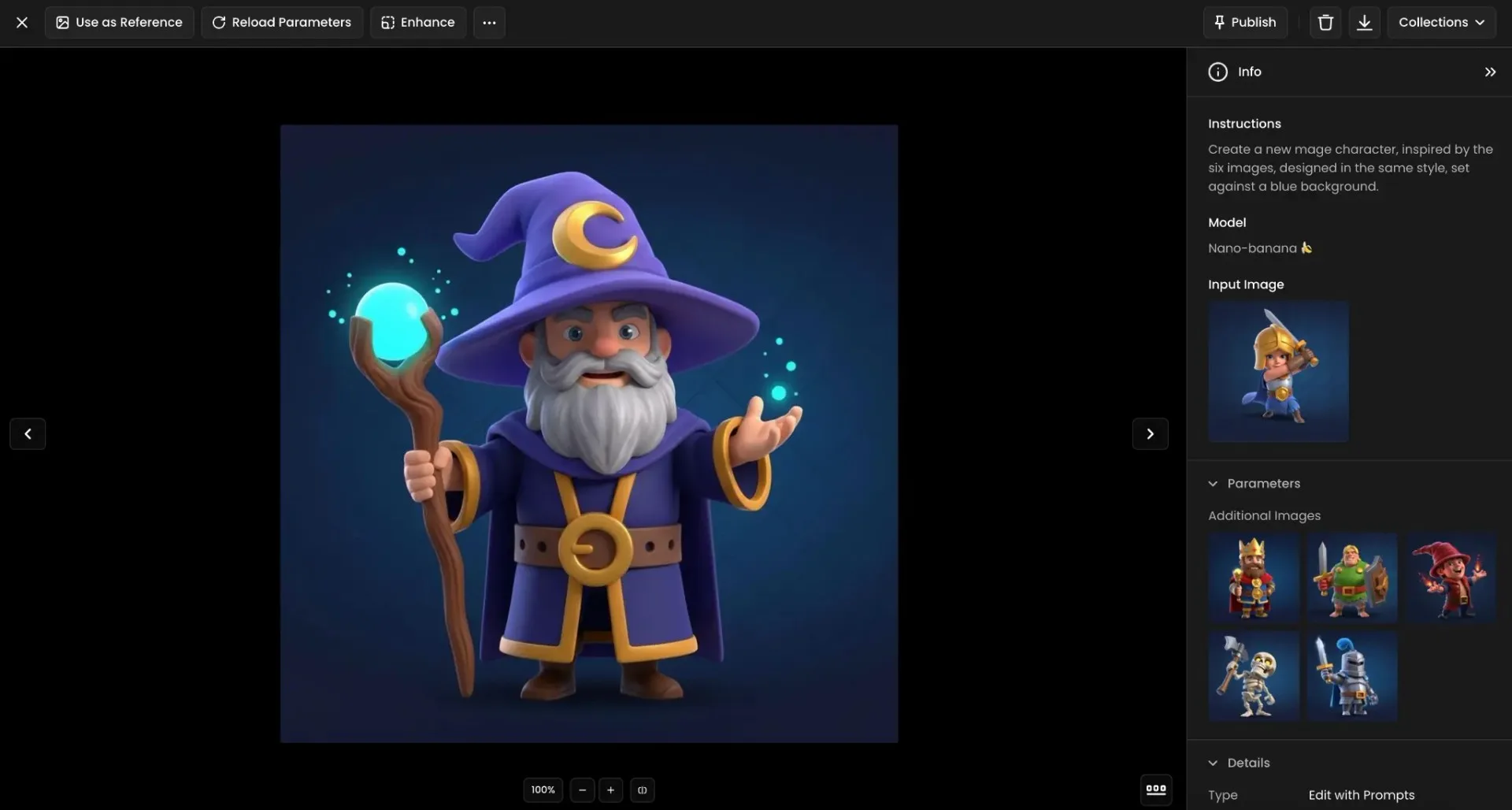
Mage in purple robes holding glowing staff.
6. Camera Angle Change
Reconstruct scenes from entirely different viewpoints and camera positions, effectively creating new shots that weren't captured in the original image. This involves understanding 3D spatial relationships, adjusting perspective distortion, and maintaining proper proportions when viewing subjects from new angles.
Use Case: A performer is reframed from a side angle close-up with raised arm pose, transforming the original perspective completely.
Prompt: "Make a close-up shot of her from the side with her in a pose with her left arm raised"
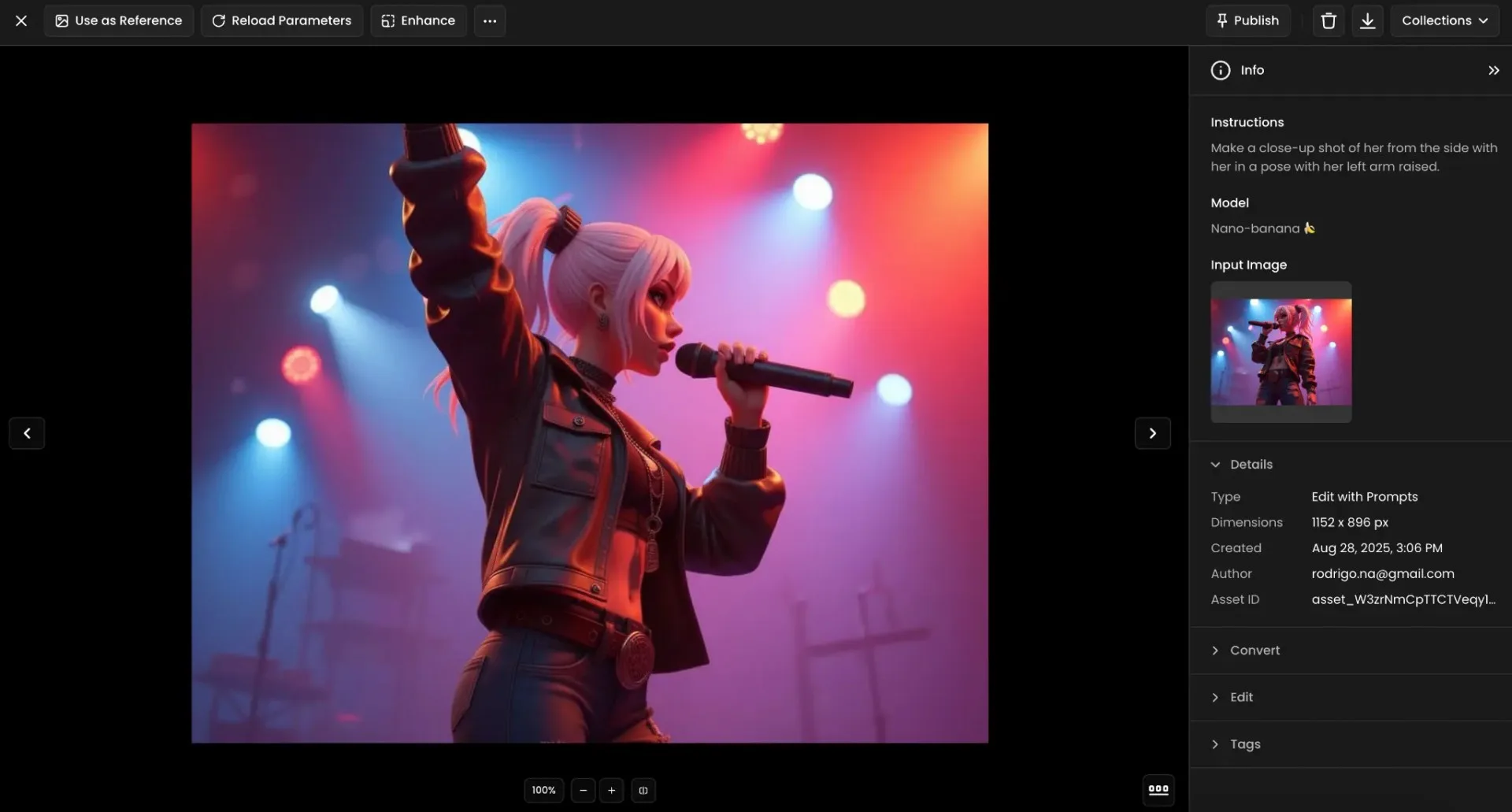
Singer performing under vibrant stage lights.
7. Material Property Change
Transform surface materials and textures while preserving underlying object geometry and form, applying realistic physical properties like reflectivity, transparency, roughness, and color temperature. The AI understands how different materials interact with light and applies appropriate highlights, shadows, and environmental reflections.
Use Case: A natural butterfly is converted into a shiny polished gold version while preserving wing patterns and anatomical details.
Prompt: "make the butterfly a shiny polished gold butterfly"
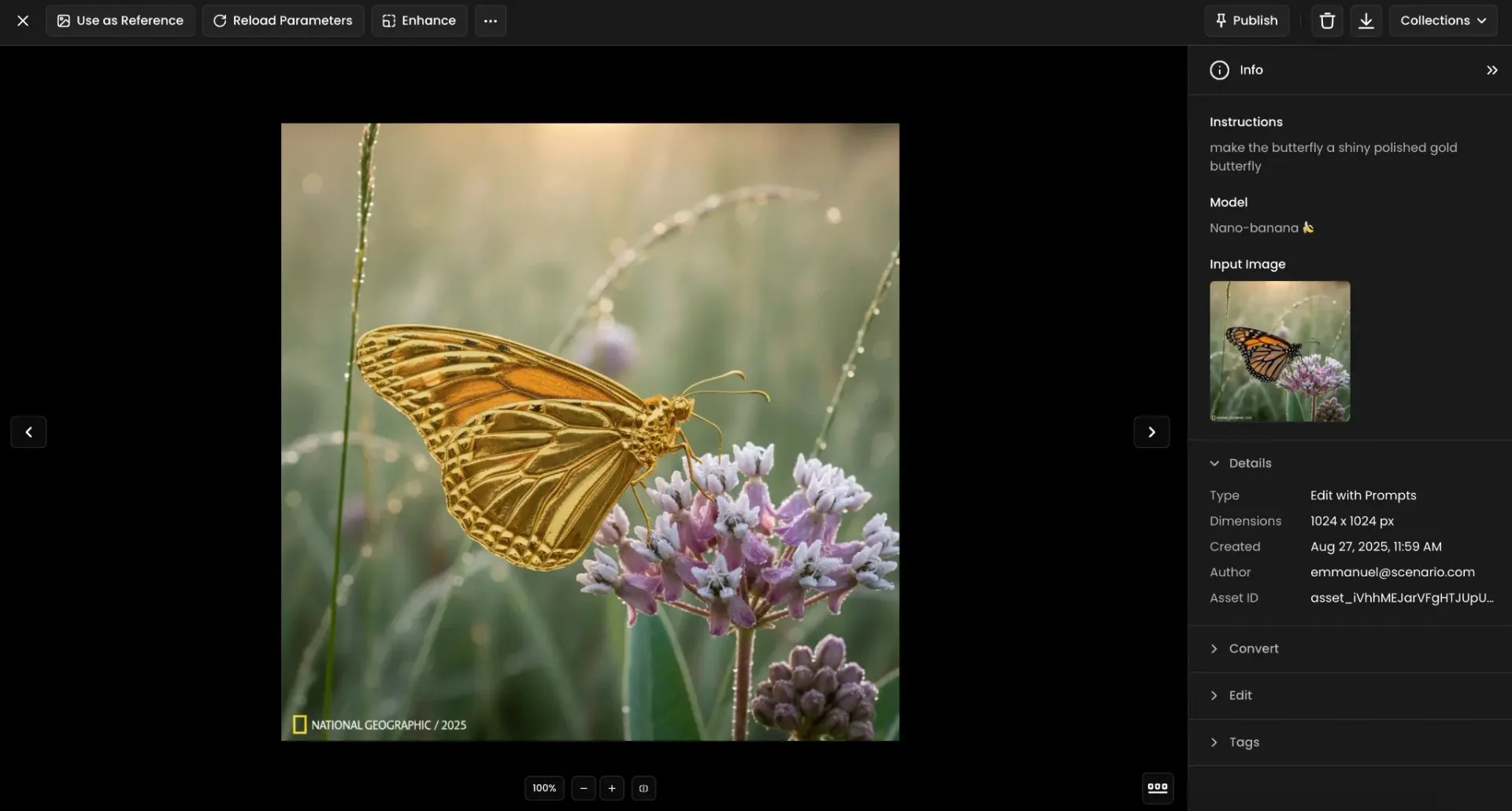
Golden butterfly on purple wildflowers.
8. Costume and Equipment Swap
Execute complex wardrobe changes involving multiple simultaneous modifications to clothing, accessories, and equipment while maintaining proper fit, proportions, and realistic fabric behavior. This includes color changes, texture modifications, and complete item replacements with appropriate lighting adjustments.
Use Case: A LEGO figure's green work suit becomes red and yellow, wrench is removed, and welding helmet is replaced with a blue beanie.
Prompt: "Change green work suit to red and yellow, remove wrench, replace welding helmet by a blue beanie"
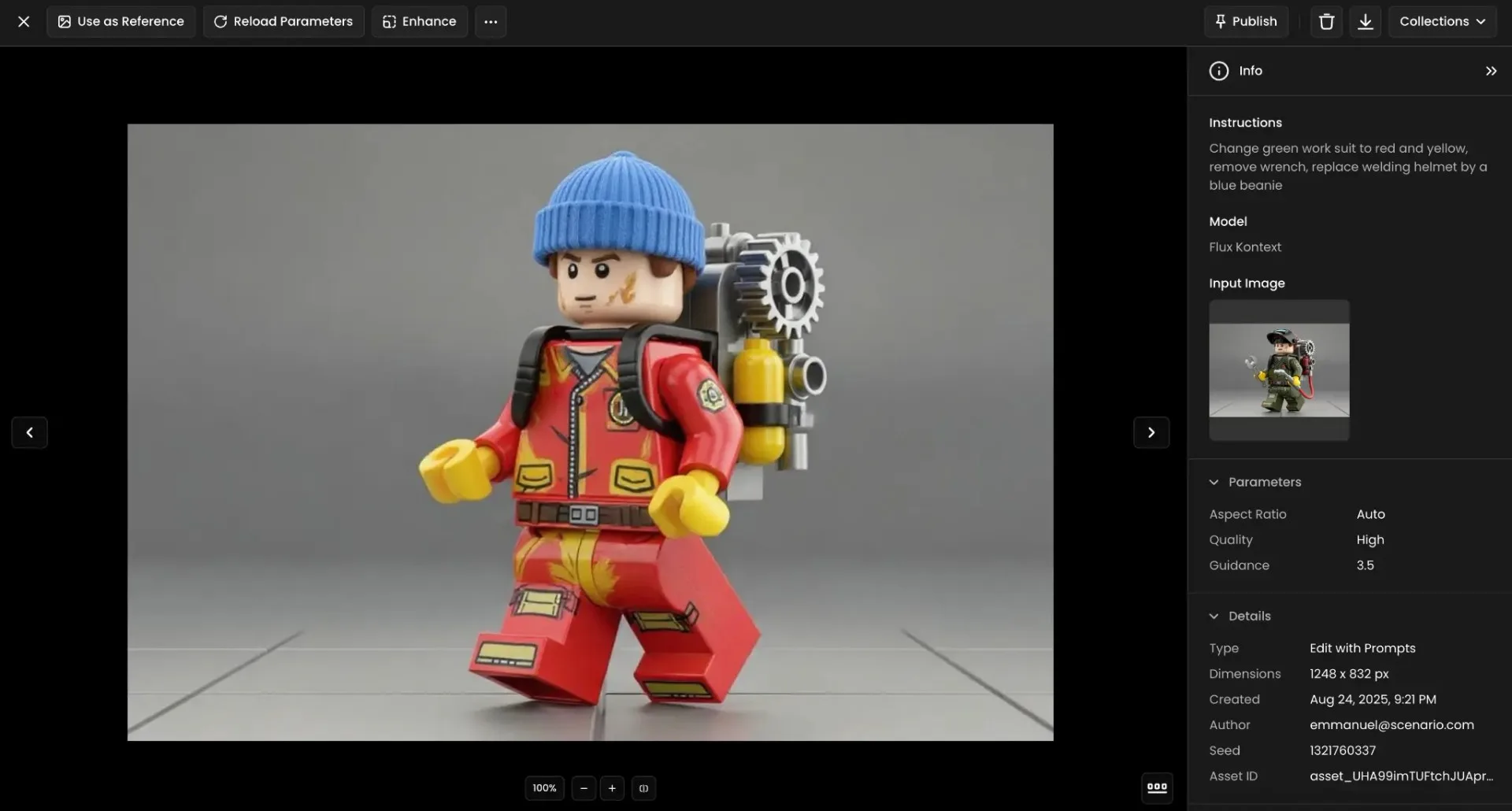
LEGO worker in red jumpsuit and blue beanie.
9. Photo to Cartoon Style
Convert photorealistic imagery into various illustrated styles, from bold cartoon aesthetics to subtle artistic interpretations, while maintaining compositional integrity and narrative content. The transformation involves simplifying complex details, adjusting color palettes, and applying stylistic rendering techniques that match target art styles.
Use Case: A realistic desert gas station scene with a man is transformed into a bold cartoon illustration style.
Prompt: "Convert the man and background into a bold cartoon style"
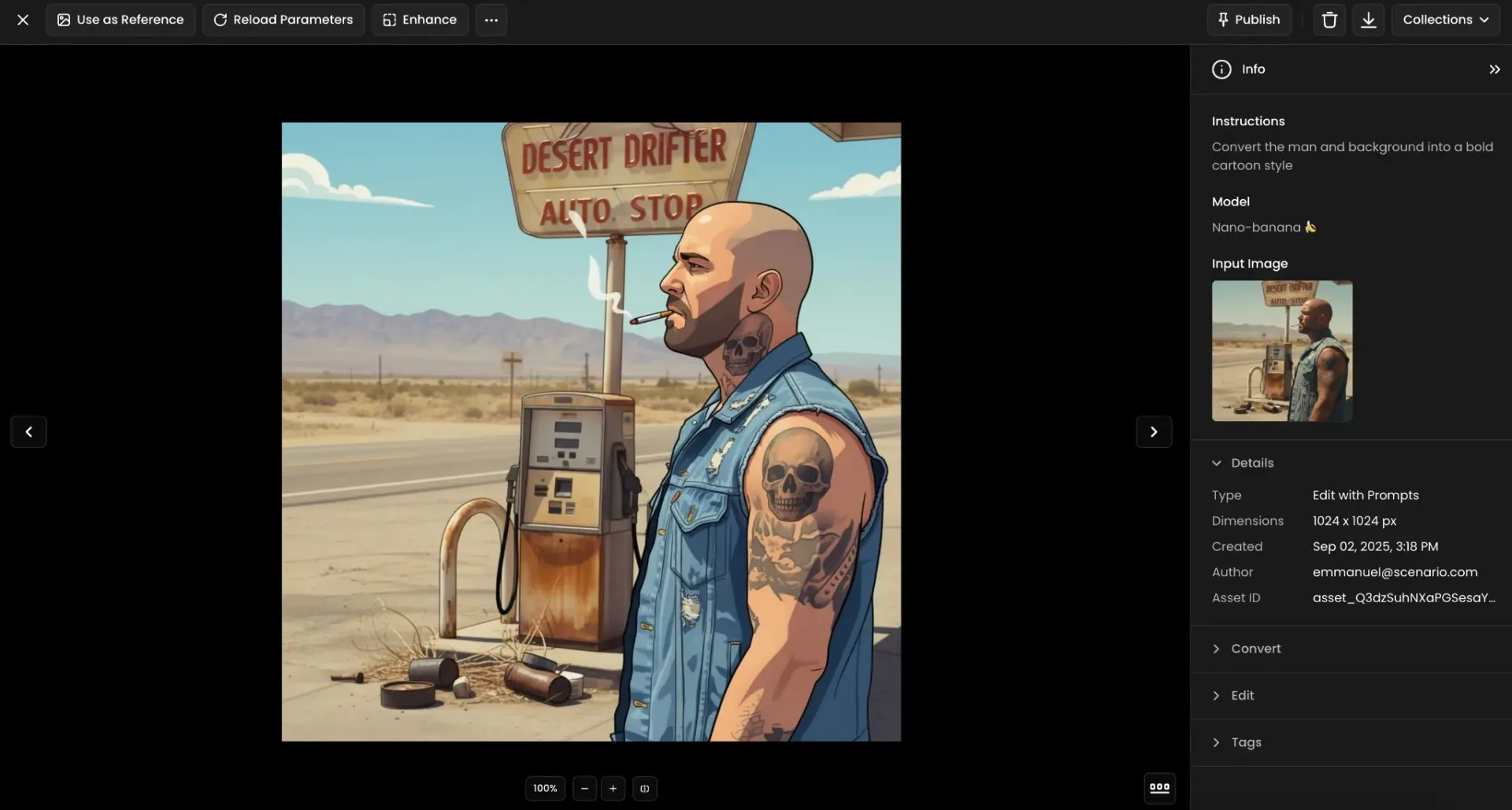
Man at abandoned desert gas station.
10. Scene Weather and Season Change
Completely transform environmental conditions, seasonal elements, and atmospheric effects while maintaining scene composition and character placement. This involves adding or removing weather effects, changing vegetation states, adjusting lighting temperature, and modifying clothing to match new environmental conditions.
Use Case: A summer city street is converted to a winter evening with snow, holiday lights, warm window glows, and winter-dressed pedestrians.
Prompt: "Change the scene to a winter evening with falling snow. Add holiday lights to the trees and a warm glow from the windows. The streets should be covered in snow, people are wearing winter coats, and there are no flowers visible, since it's winter."
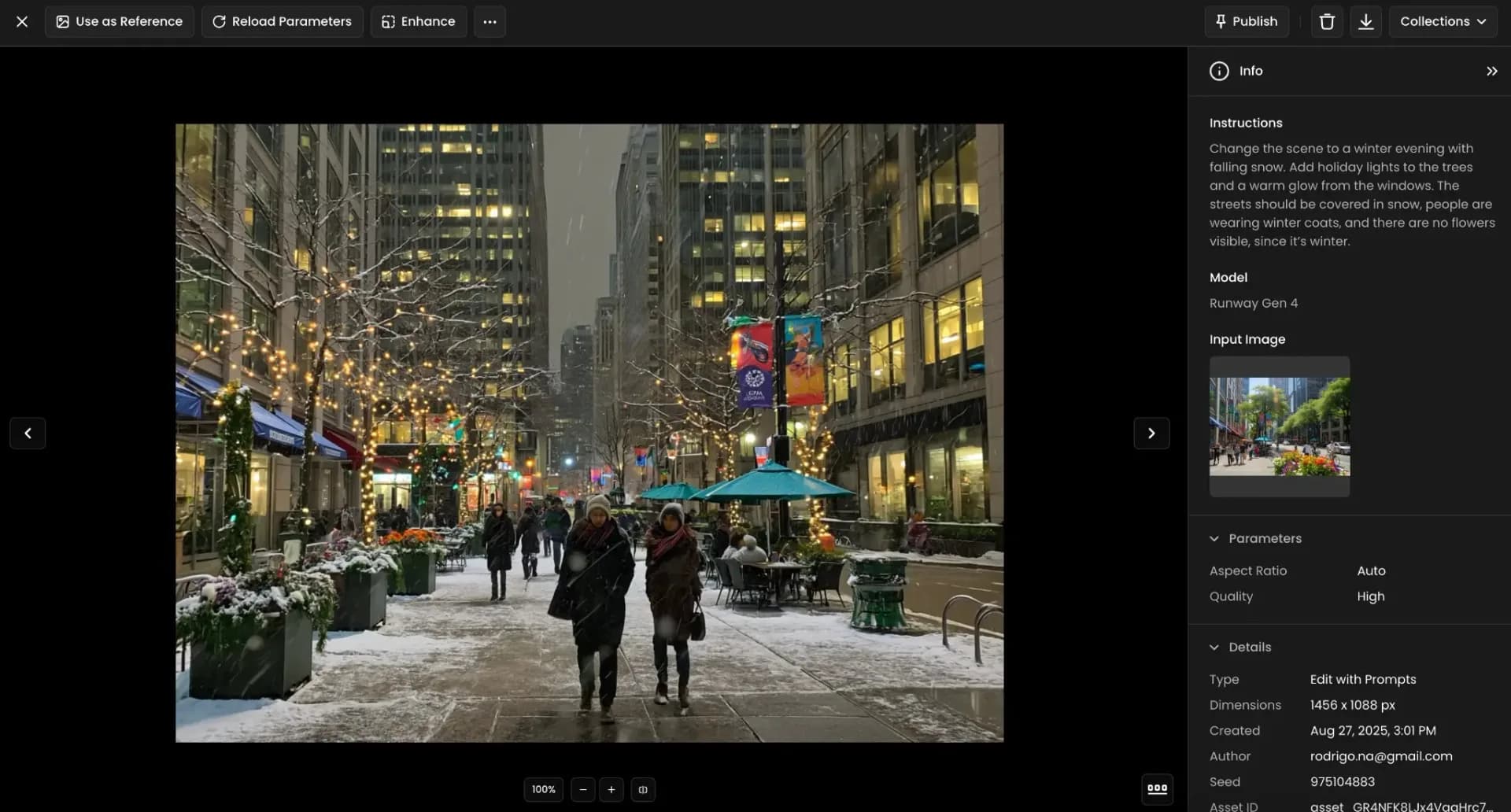
Snowy city street with holiday lights at night.
11. Asset Creation from References
Generate new assets that seamlessly integrate with existing art collections by analyzing multiple reference images to extract and apply consistent style guidelines, technical specifications, and aesthetic principles. This ensures new creations maintain visual harmony with established asset libraries.
Use Case: A vintage voxel car is created using reference vehicle images, matching "The Sandbox" game's distinctive voxel art style.
Prompt: "Make a new vintage vehicle, inspired by the images of the provided vehicles, in the same voxel art style in the style of 'The Sandbox' (the game)"
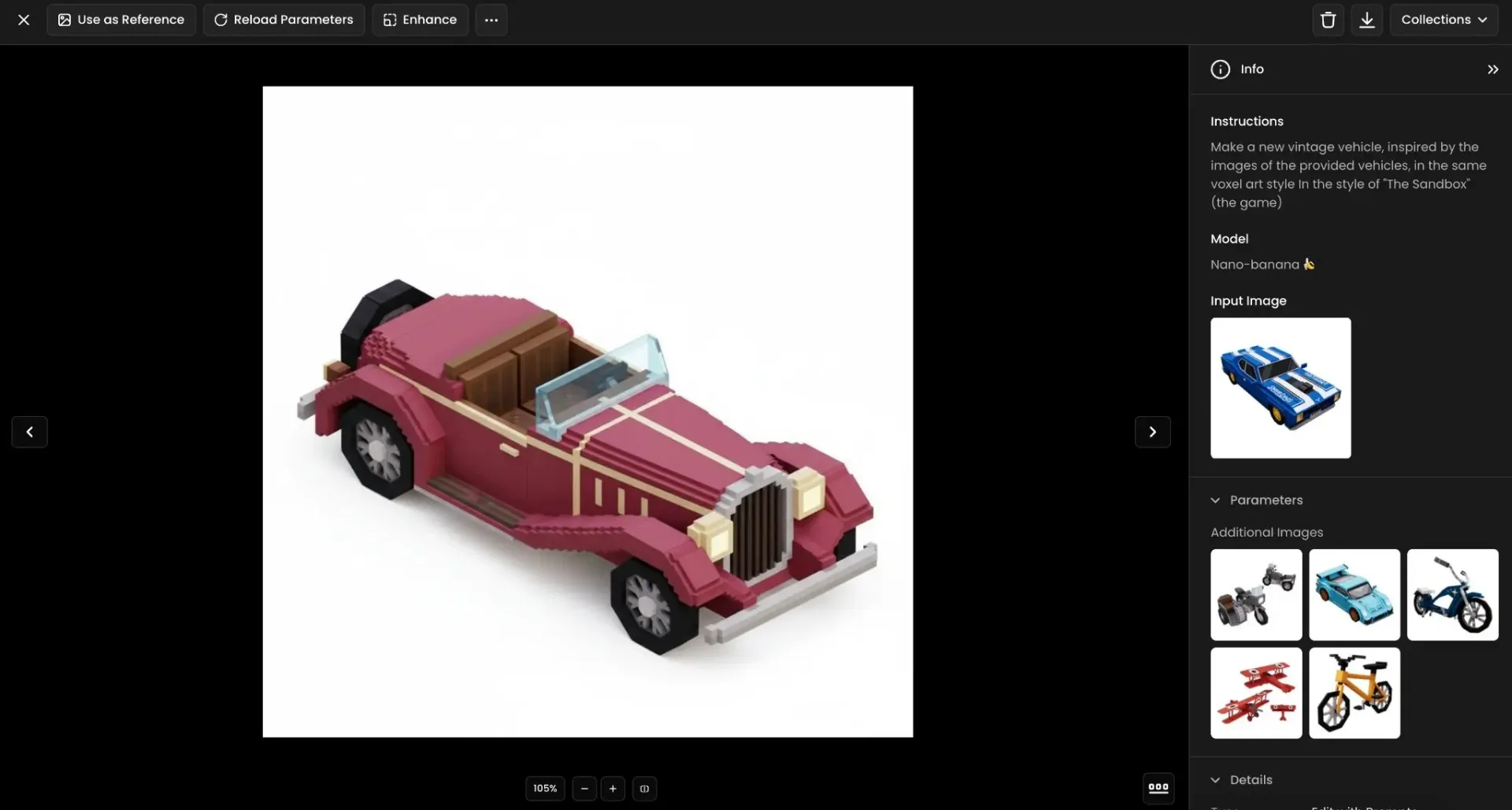
Voxel art vintage car with maroon body.
12. Character Battle Positioning
Arrange multiple characters in dynamic combat scenarios with proper spatial relationships, weapon positioning, and action choreography that conveys movement, tension, and narrative conflict. The AI considers reach distances, defensive stances, and energy effects to create believable fight compositions.
Use Case: A skeleton warrior and wizard are positioned facing each other in aggressive battle stances, ready for combat.
Prompt: "Position both characters facing each other in aggressive battle stances"
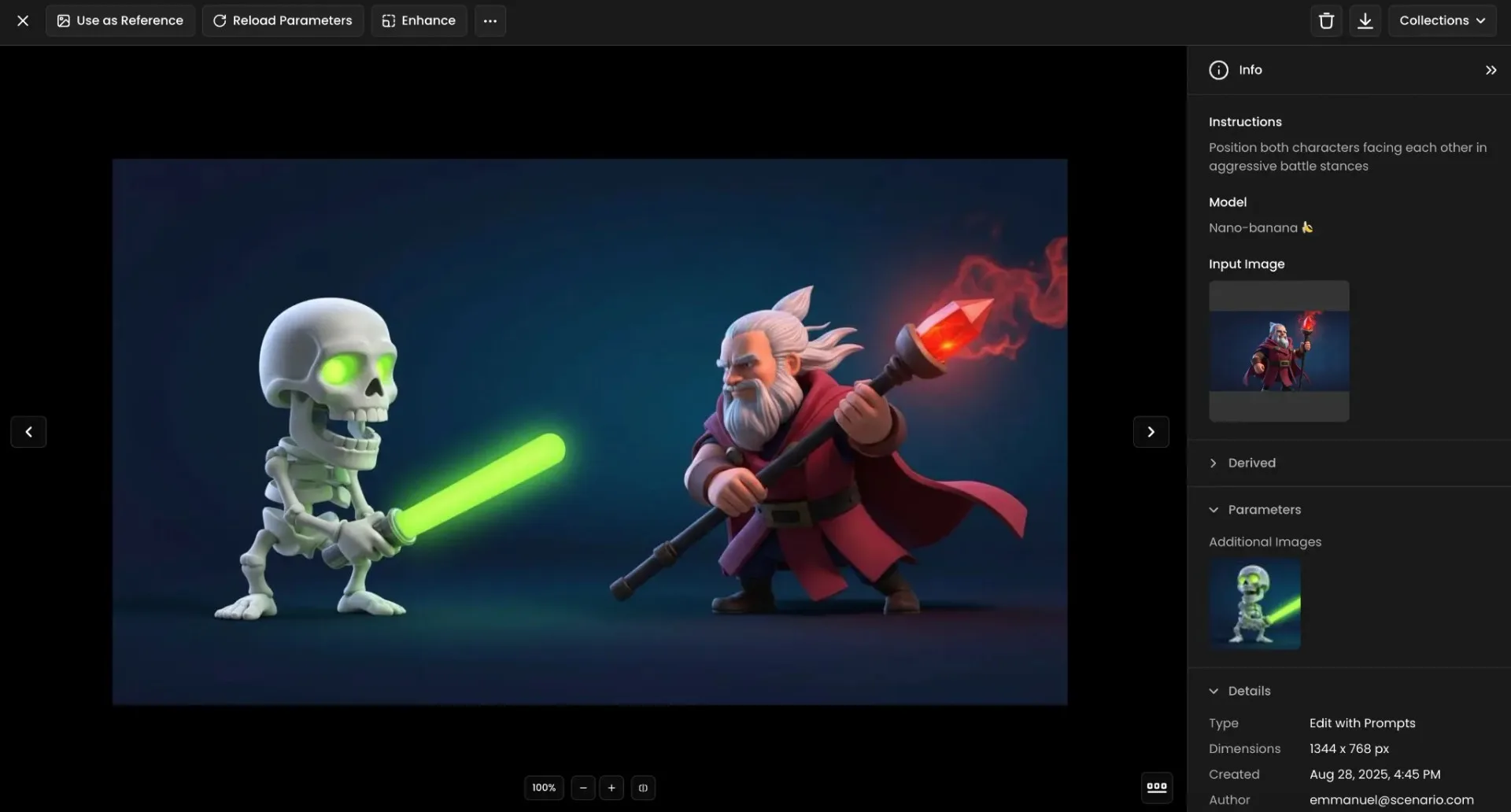
Skeleton and wizard face off in battle.
13. Lifestyle and Vehicle Change
Transform characters and their associated objects to represent completely different lifestyles, subcultures, or social contexts while maintaining character identity and proportions. This involves coordinated changes to clothing, accessories, vehicles, and environmental elements that support the new thematic direction.
Use Case: A casual cyclist with basket and bottle becomes a leather-clad biker on a stylish motorcycle, removing all casual elements.
Prompt: "Put on leather biker-style clothes and also change the bicycle to a stylish motorcycle. Remove the bread basket and the bottle as well."
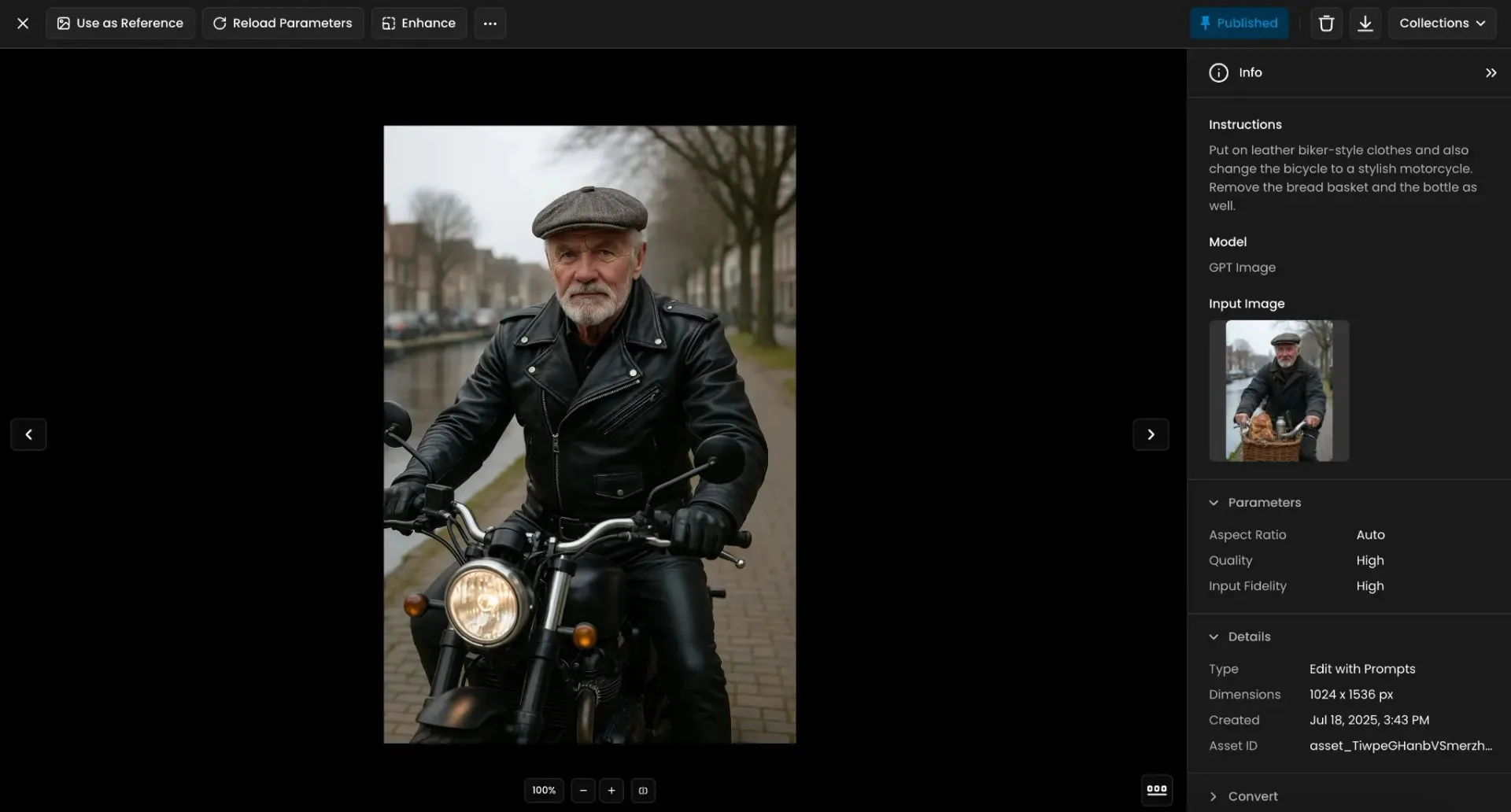
Older man in leather jacket riding motorcycle.
14. Historical Costume Change
Replace contemporary or fantasy clothing with historically accurate garments from specific time periods, including appropriate accessories, fabrics, and styling details that reflect authentic historical fashion and cultural context. The AI considers period-appropriate colors, materials, and construction methods.
Use Case: A pirate character is transformed into a Roman sailor with period-appropriate clothing and accessories.
Prompt: "Replace pirate outfit with antique Roman sailor clothing"
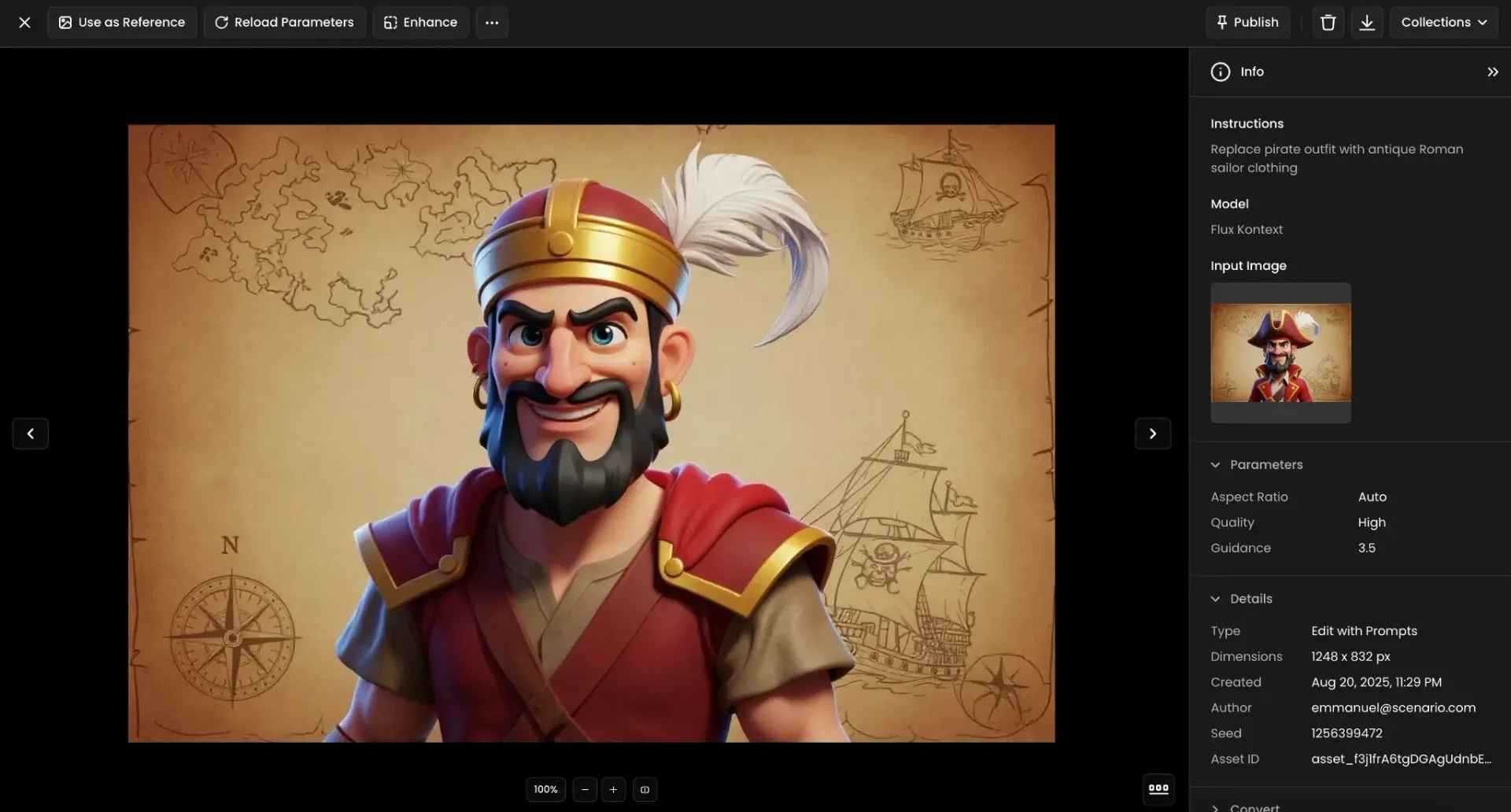
Animated Roman sailor with antique map backdrop.
15. Combat Scene Creation
Orchestrate dynamic battle sequences with precise character positioning, weapon engagement, and energy effects that convey motion, impact, and dramatic tension. This involves coordinating multiple elements like stance dynamics, magical effects, environmental interaction, and visual storytelling through body language.
Use Case: A skeleton warrior and wizard are positioned in active combat stances with weapons engaged and dynamic energy effects.
Prompt: "change the pose, fighting"
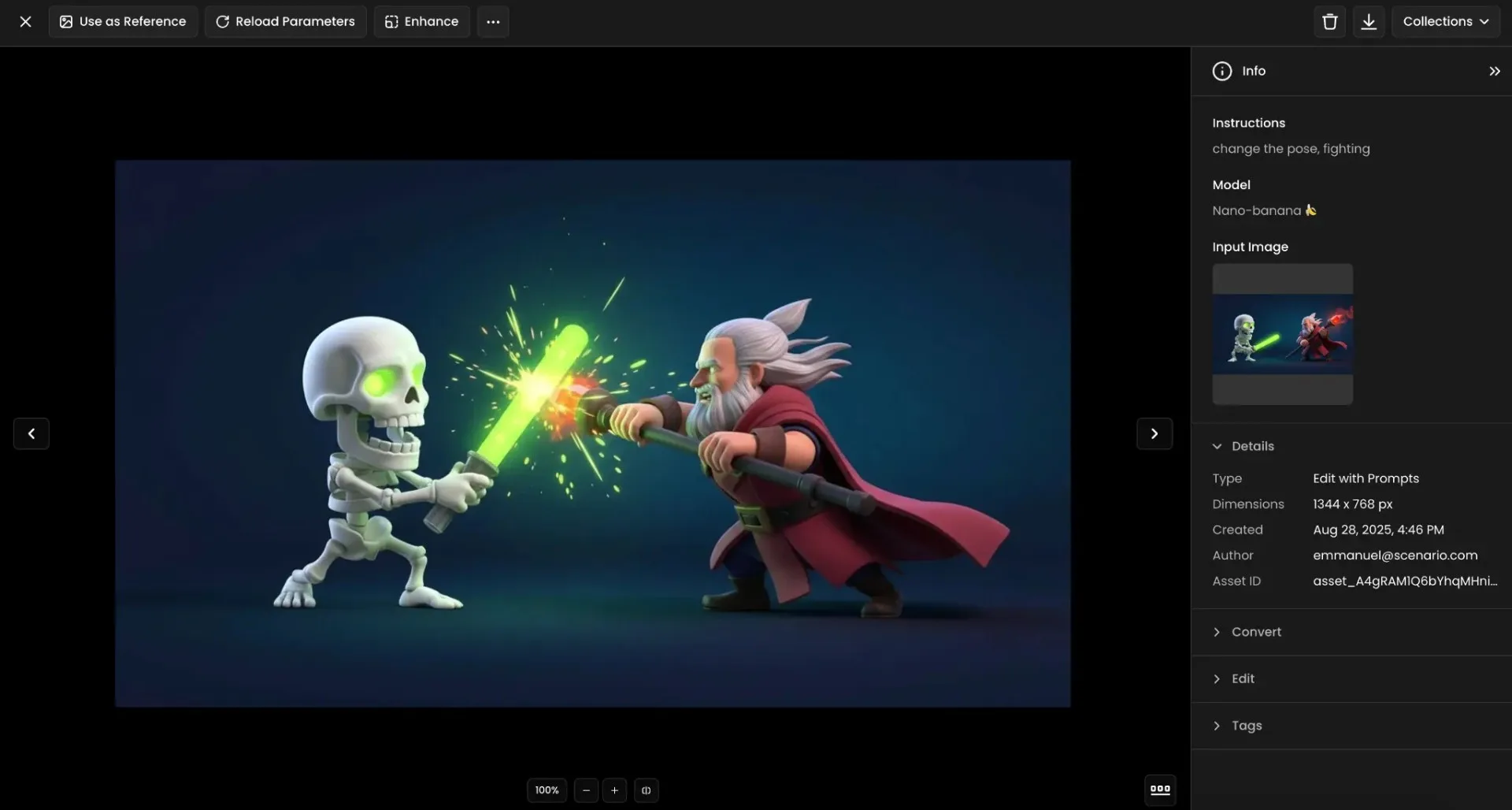
Skeleton and wizard duel with glowing staffs.
16. Battle Outcome Scene
Depict the aftermath of combat scenarios with defeated characters, victory poses, and environmental evidence of the conflict that just concluded. This creates narrative continuity by showing cause-and-effect relationships and emotional consequences through character positioning and environmental details.
Use Case: The battle concludes with the skeleton defeated on the ground, lightsaber deactivated, while the wizard stands victorious with raised staff.
Prompt: "the skeleton is lying on the ground, on the side. the green light saber is off. The wizard raises one hand, holding the staff vertically"
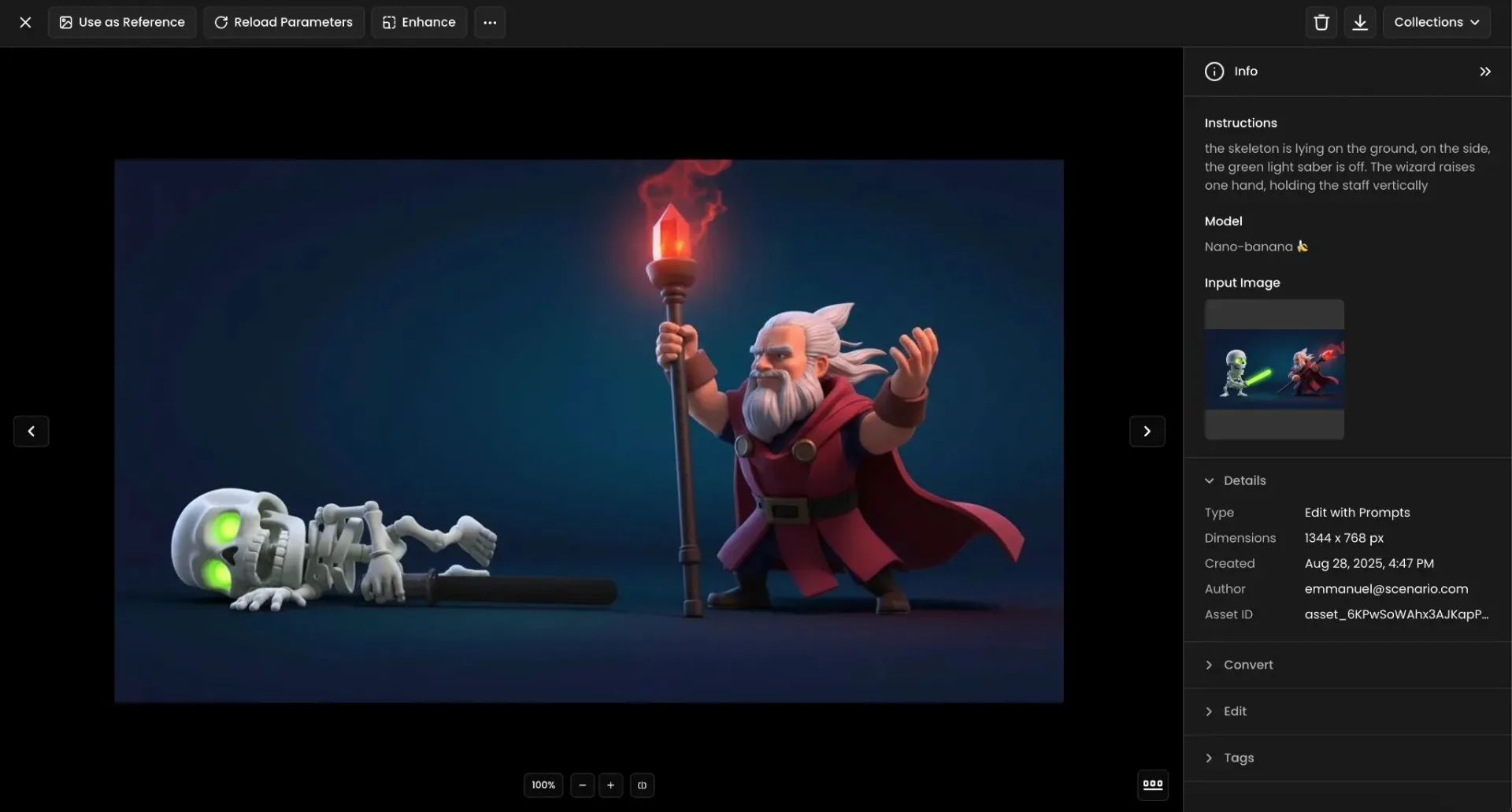
Wizard with staff and skeleton with green eyes
17. Cultural Costume Transformation
Transform characters into authentic cultural representations with traditional clothing, accessories, and styling that accurately reflects specific cultural heritage and ceremonial contexts. This involves understanding cultural significance, appropriate color symbolism, and traditional garment construction while maintaining respectful representation.
Use Case: A character is transformed into a Brazilian carnival dancer with vibrant feathered headdress, colorful costume, and festive pose.
Prompt: "Create a Brazilian character dancing with vibrant carnival attire"
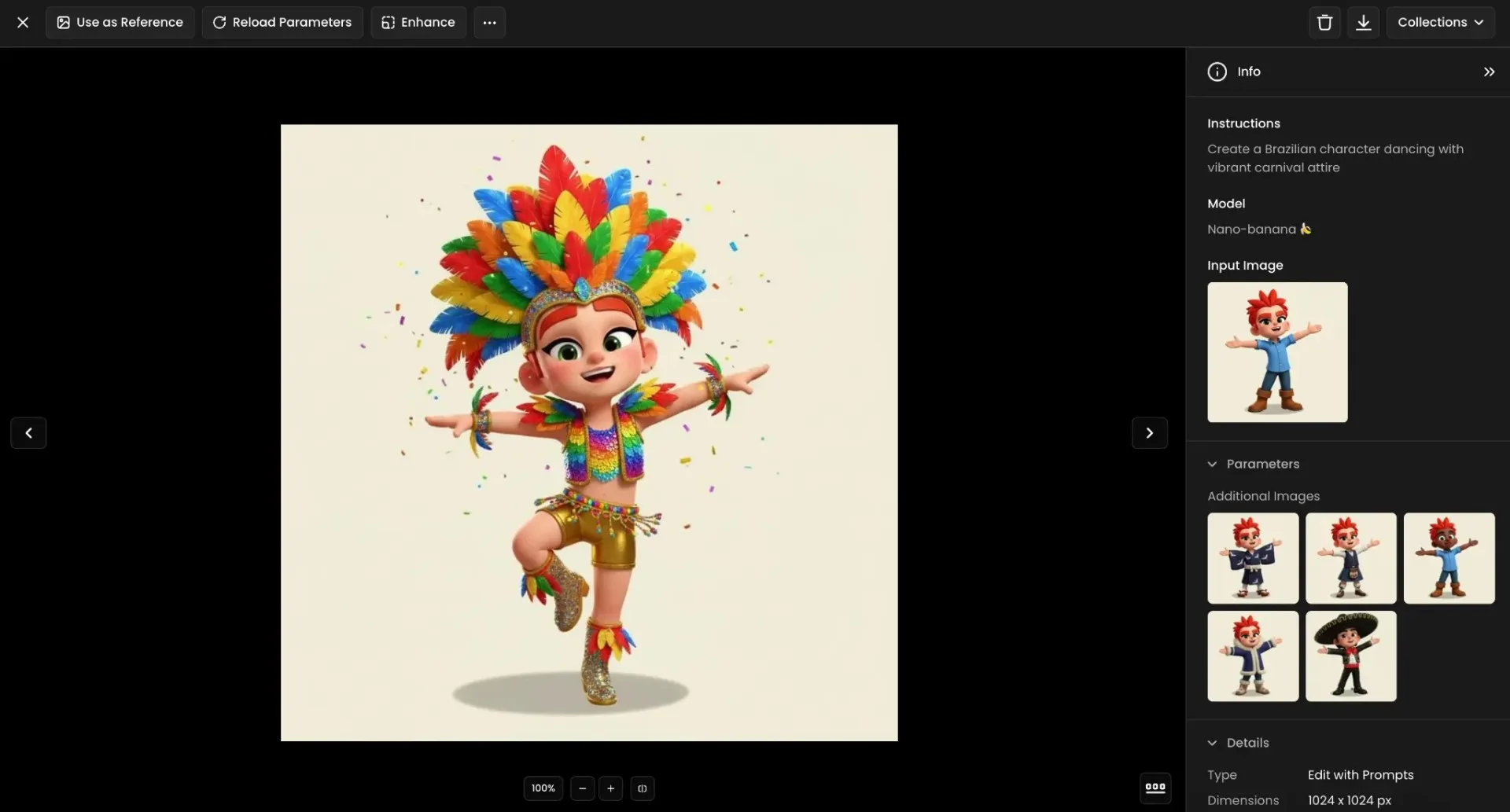
Animated character in colorful Brazilian carnival costume dancing.
18. Clothing Item Extraction
Isolate and display individual garments or accessories as standalone objects, removing characters while preserving detailed fabric textures, construction details, and realistic draping or structural properties. This creates clean product shots or reference materials for fashion design and character customization systems.
Use Case: A character's coat and boots are extracted and displayed as separate items, removing the character while preserving clothing details.
Prompt: "separate the different elements from the character. Display the coat and the boots only, next to each other"
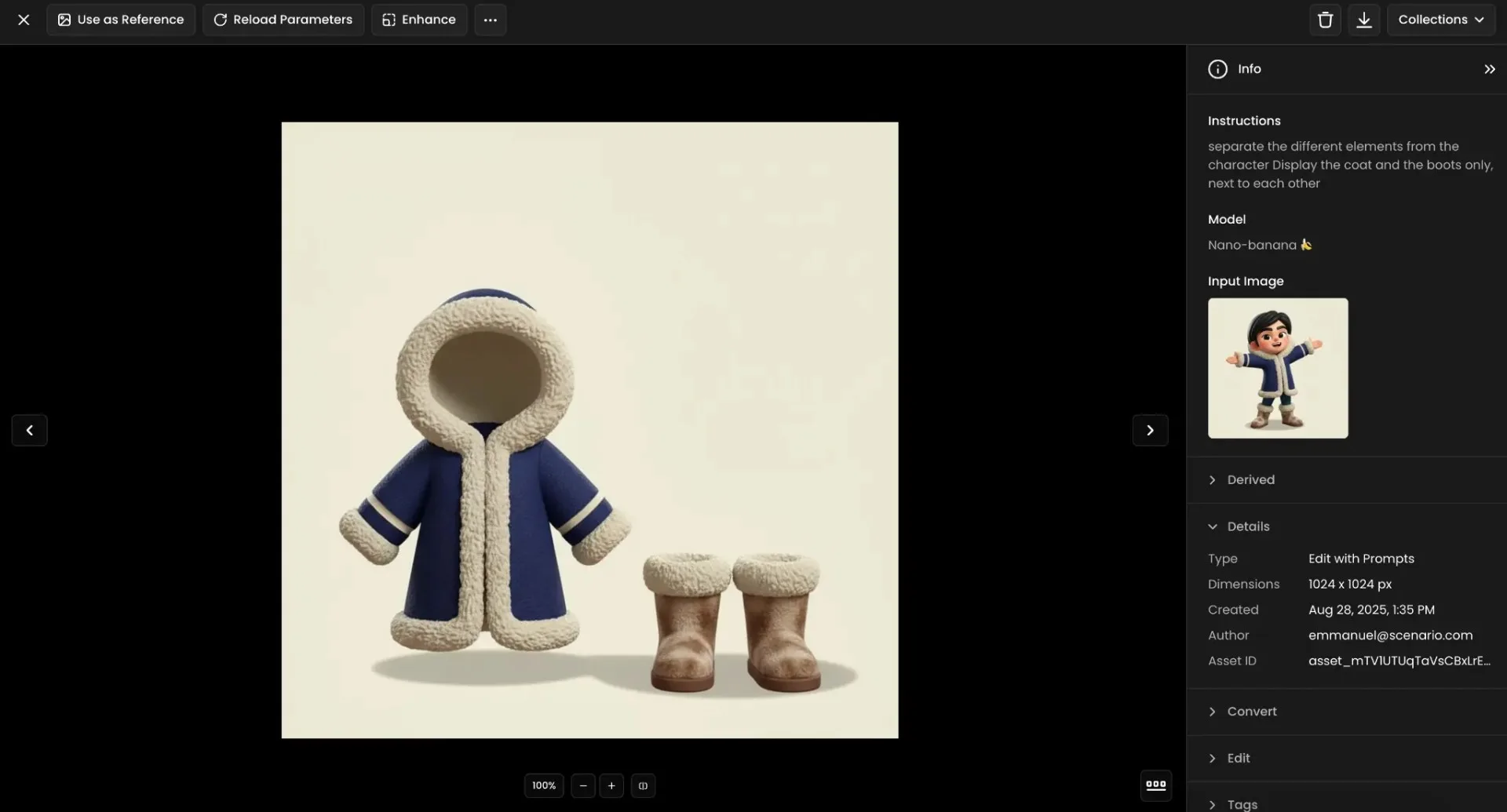
Blue winter coat and boots side by side.
19. Character Theme Change
Transform characters into entirely different archetypes or thematic representations while maintaining core facial features and proportions, involving comprehensive changes to clothing, accessories, posture, and environmental context that support the new character role or profession.
Use Case: A character is completely transformed into a cowboy with authentic western hat, bandana, vest, and boots.
Prompt: "change to a cowboy"
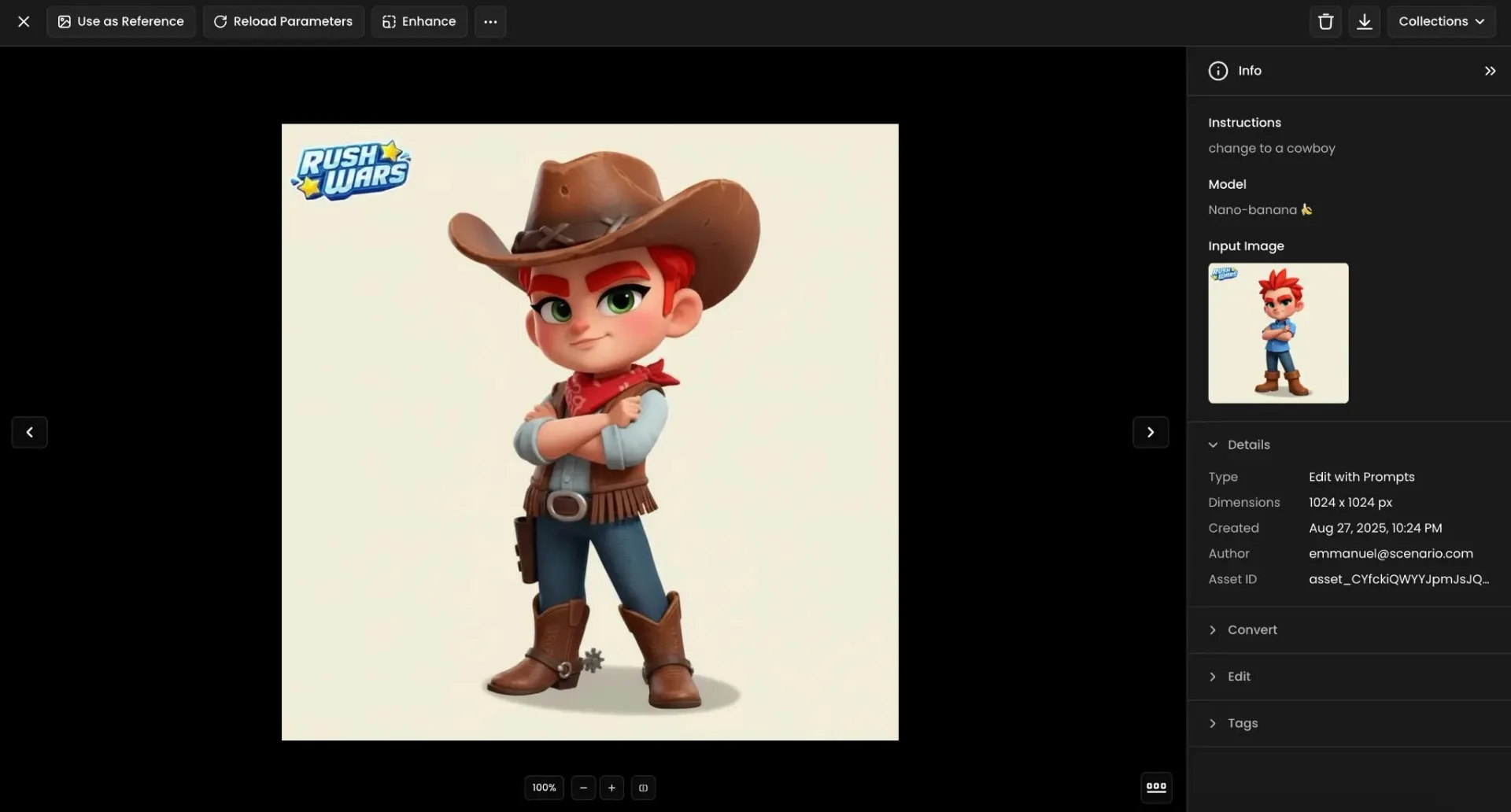
Cartoon cowboy character from Rush Wars game.
20. Background with Themed Elements
Replace existing backgrounds with thematically appropriate environments that enhance character narratives and provide visual context through symbolic or literal environmental storytelling. This involves creating atmospheric effects, architectural elements, and environmental details that support character roles and story themes.
Use Case: Two royal characters are placed against contrasting elemental backgrounds - one with ice golem, another with fire titan.
Prompt: "Backgrounds replaced by giant elemental creatures (ice golem vs. fire titan)"
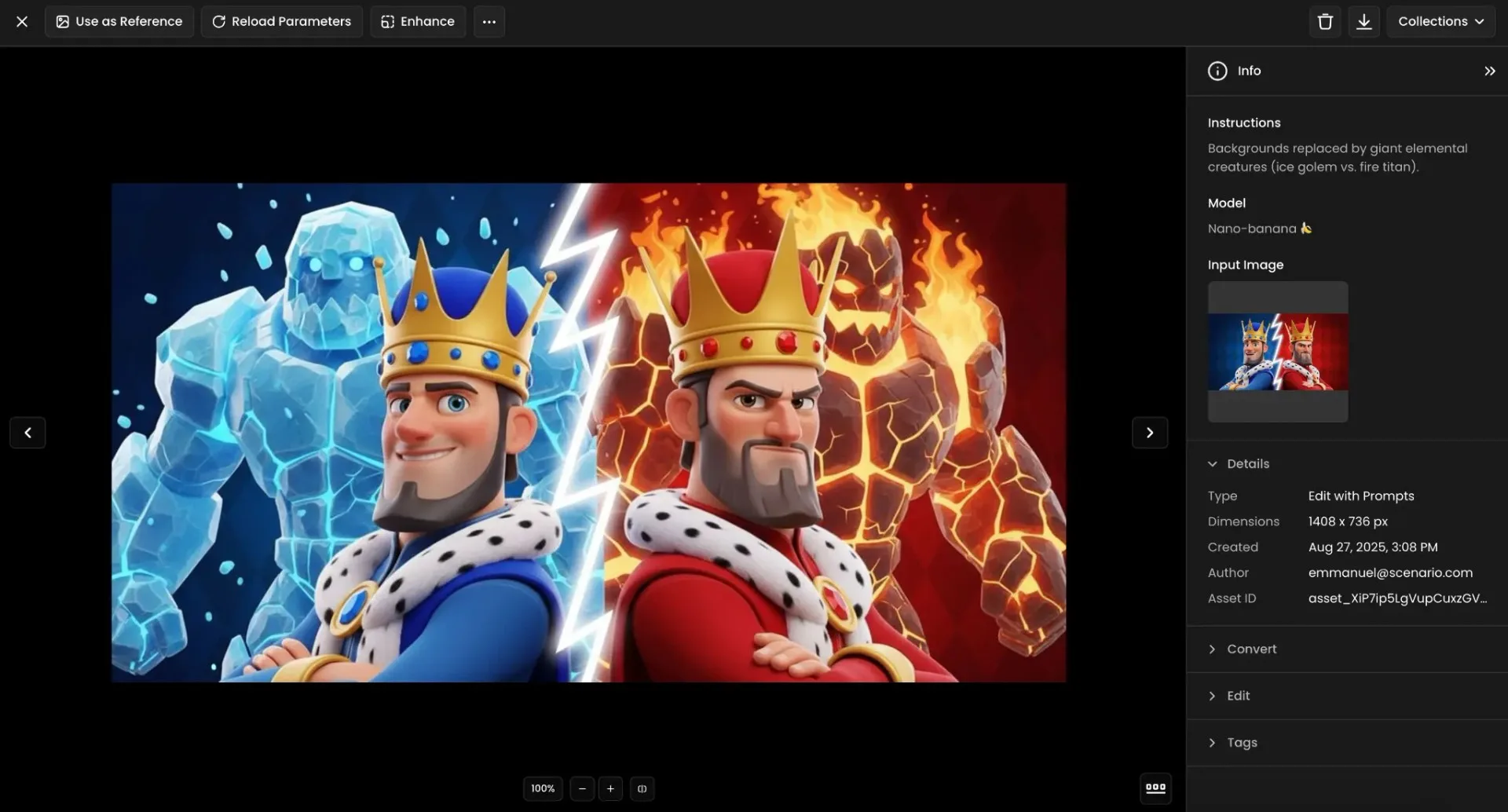
Ice and fire kings with elemental golems clash.
21. Vehicle to Sci-Fi Transformation
Convert everyday vehicles into futuristic or fantasy variants with advanced technology, energy effects, and design modifications that maintain recognizable vehicle functionality while adding speculative or fantastical elements. This includes propulsion systems, energy signatures, and technological details that suggest advanced capabilities.
Use Case: A regular car on a forest road is transformed into a glowing, hovering alien spacecraft with advanced propulsion effects.
Prompt: "Transform the car into a glowing, futuristic alien spacecraft"
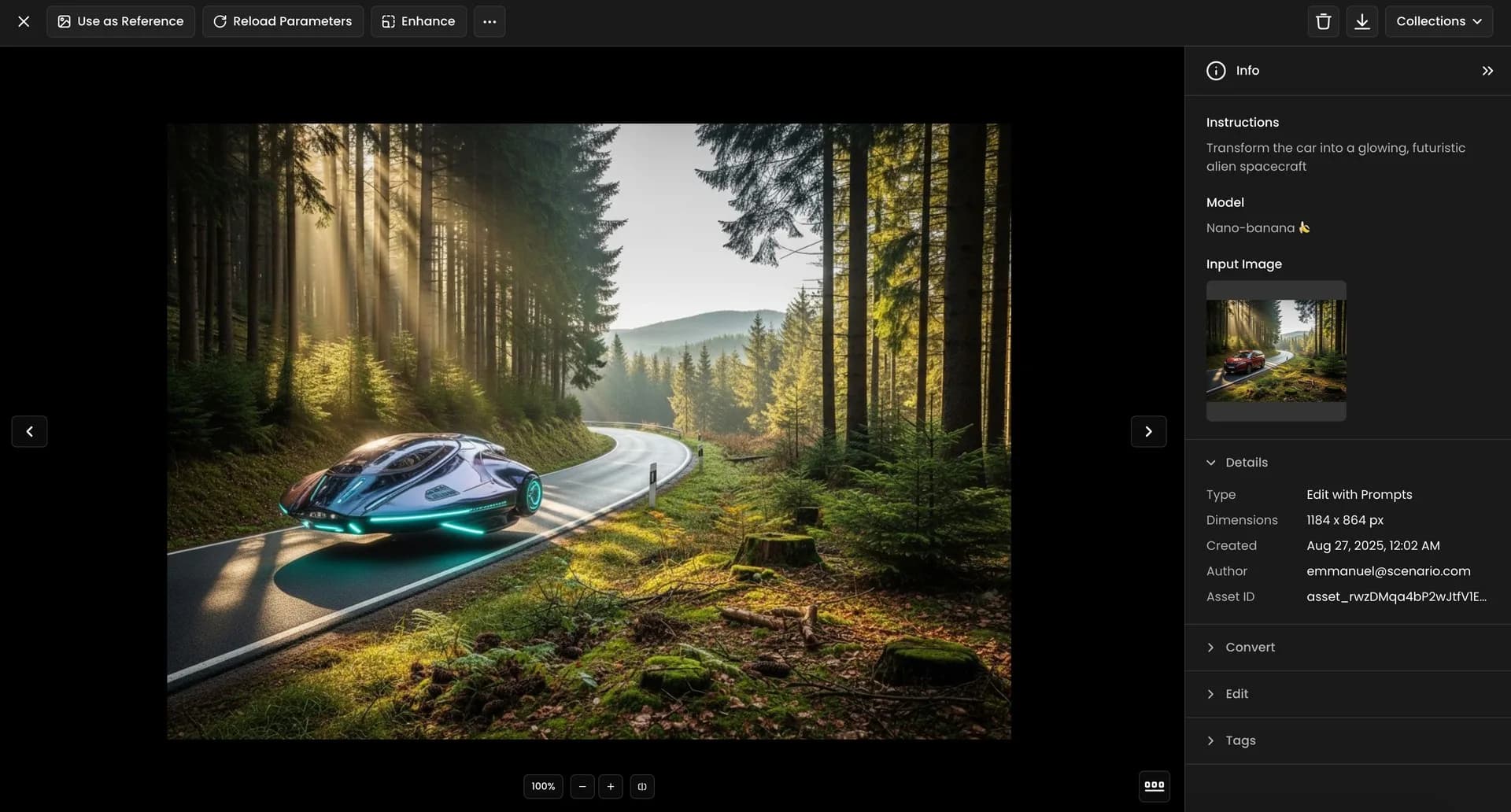
Futuristic alien spacecraft glows on forest road.
22. Character Creation Using Style References
Generate new characters by analyzing and synthesizing style elements from multiple reference images, extracting artistic DNA like proportions, color theory, shading techniques, and design philosophy to create characters that feel authentically part of established visual universes.
Use Case: A peasant character is created using the same artistic style as reference character images, complete with appropriate clothing and tools.
Prompt: "make a new character, in the same style a peasant"
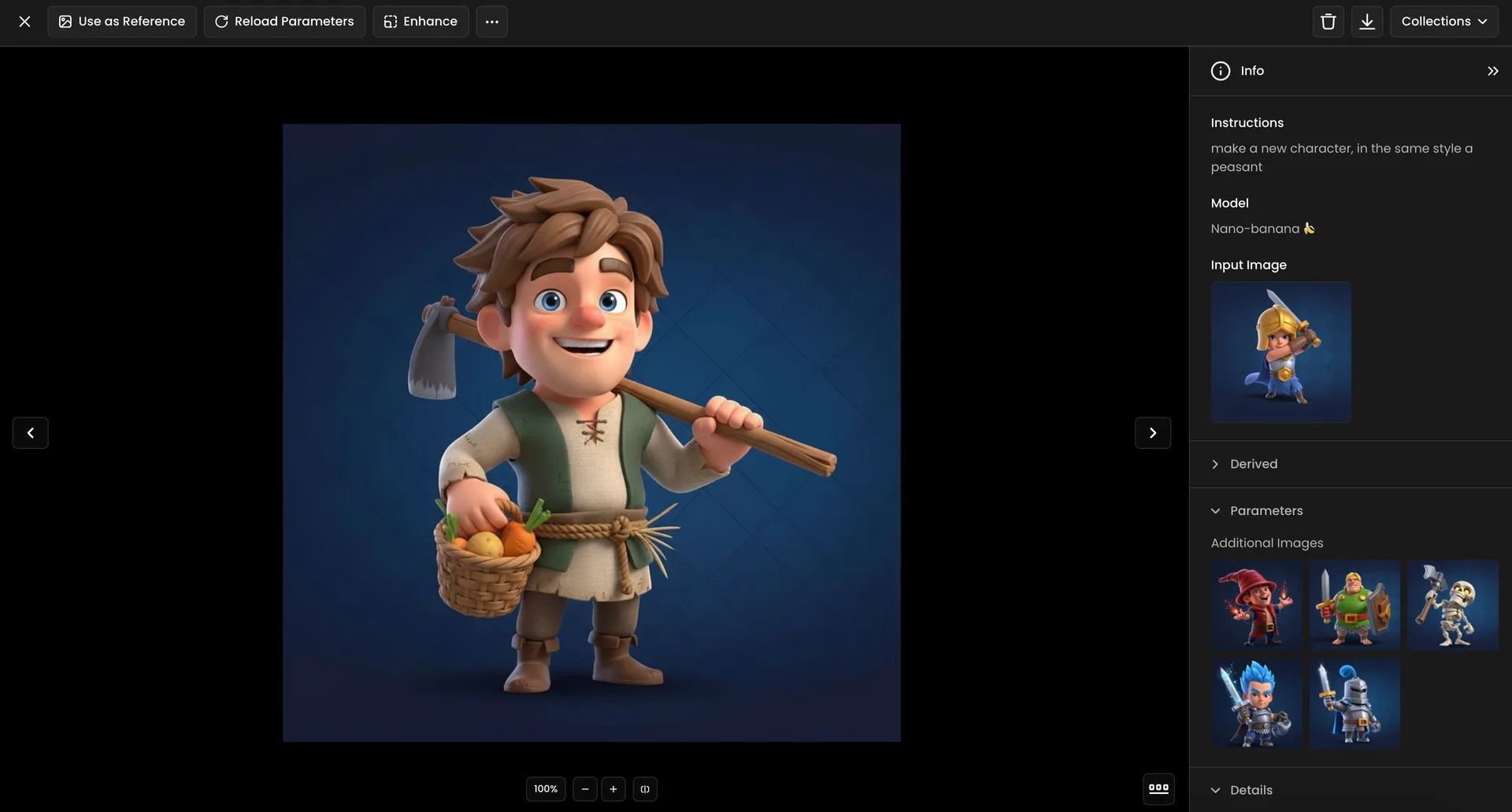
3D cartoon peasant with basket and hoe.
23. Digital Art to Product Mockup
Place digital artwork onto realistic physical products and environments to create authentic product visualization and marketing materials, including proper perspective, lighting, surface reflections, and environmental integration that makes digital art appear as tangible merchandise.
Use Case: A character illustration is placed on an old vinyl record cover sitting on a wooden table as a realistic photograph.
Prompt: "The image in on the cover of an old vinyl, on a wooden table, realistic photograph"
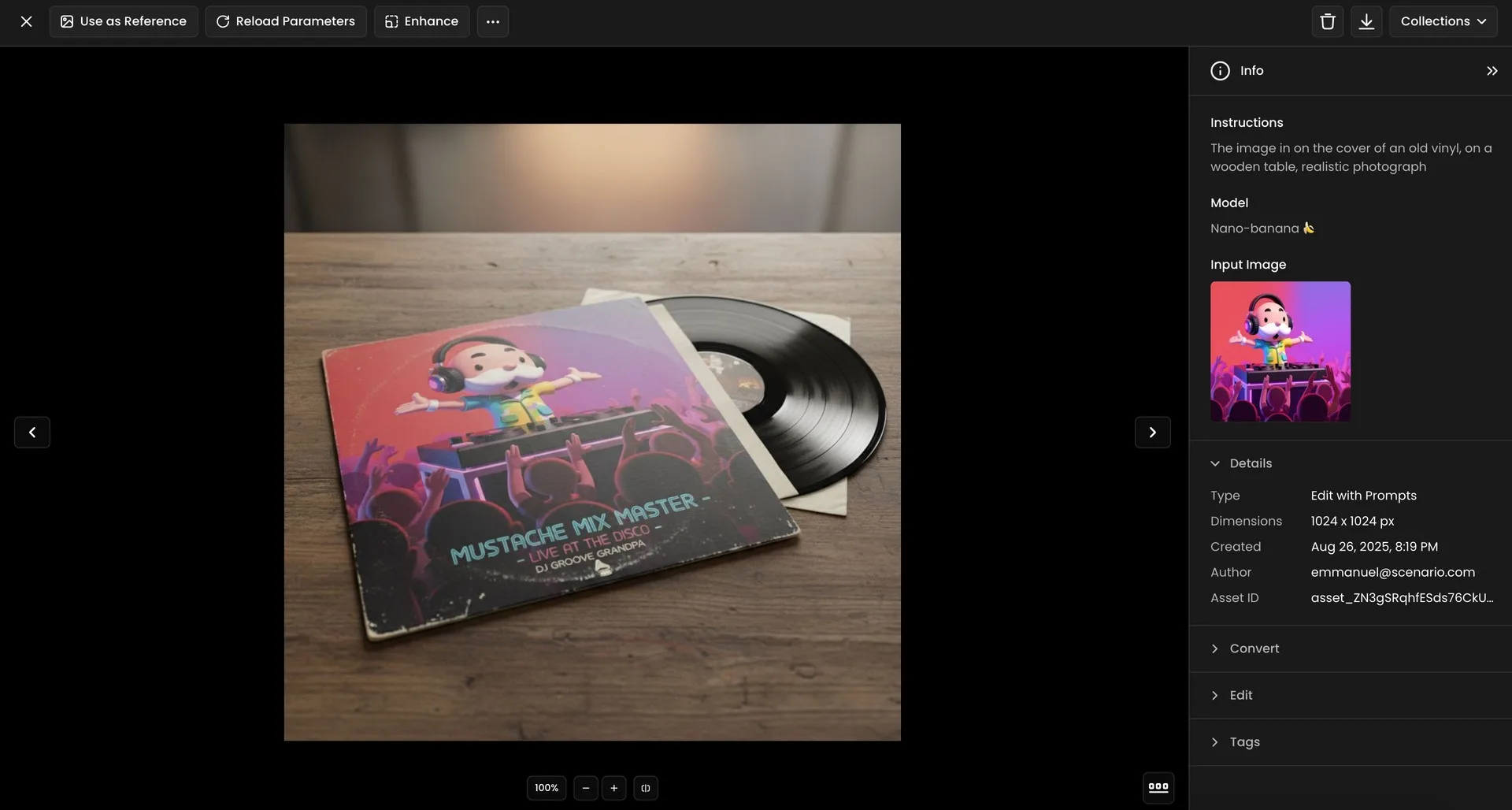
Vinyl record and DJ album cover on table.
24. Background Transformation
Replace entire environmental contexts while maintaining proper character lighting, scale relationships, and atmospheric integration, ensuring characters appear naturally placed in new settings rather than artificially composited. This involves matching lighting conditions, adjusting shadows, and adding environmental effects.
Use Case: A character is moved from a fiery, volcanic environment to the frozen landscape of Antarctica with appropriate environmental effects.
Prompt: "Make it in Antartica"
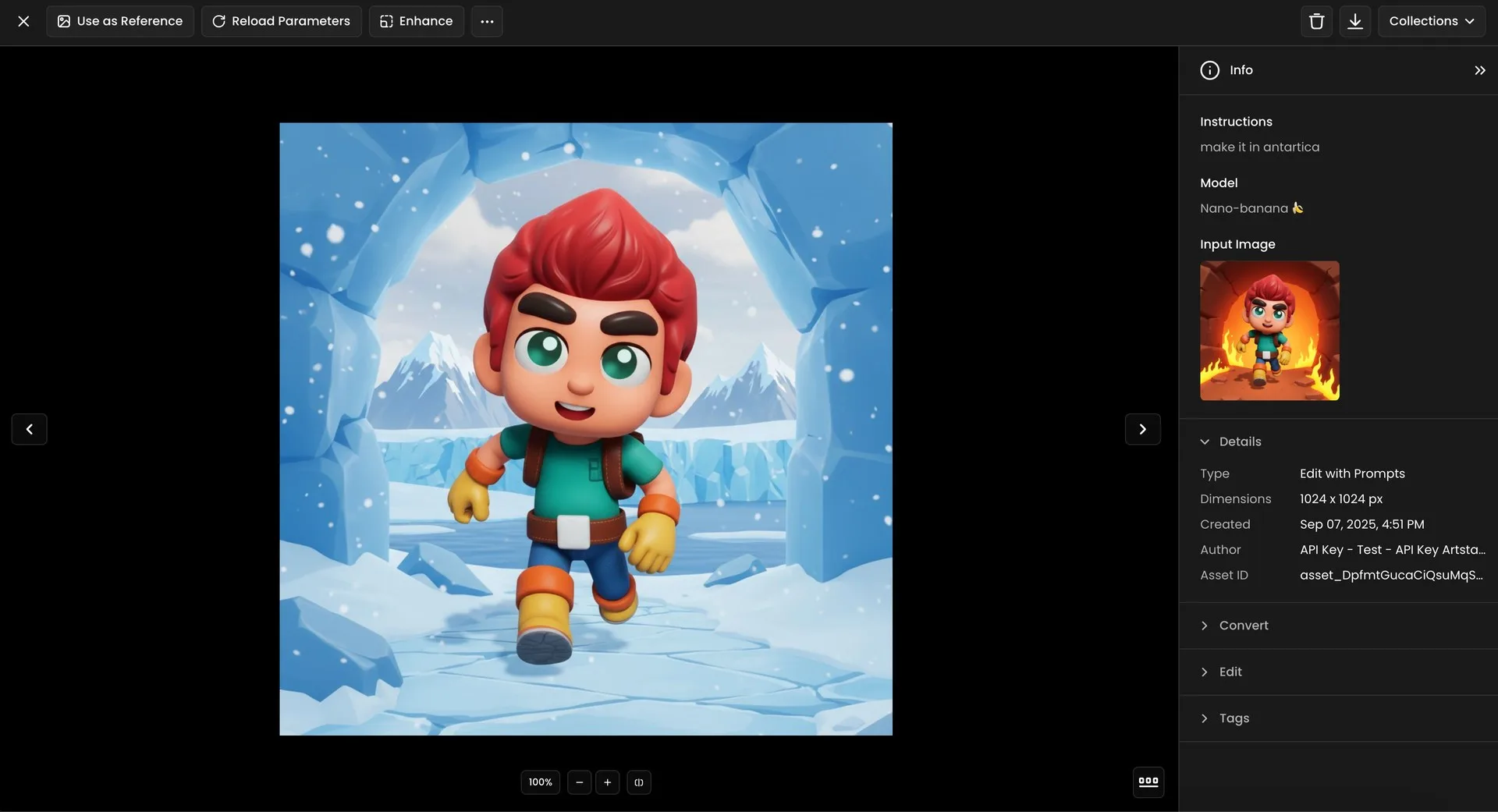
Cartoon boy explores icy Antarctica in winter.
25. Multi-Person Scene Arrangement
Orchestrate complex social scenes with multiple people positioned according to specific spatial relationships, social dynamics, and visual composition rules while maintaining natural body language and realistic interpersonal spacing. This includes coordinating eye contact, gesture relationships, and interactions with the environment.
Use Case: Three women are positioned in chairs having a conversation, with each person corresponding to specific colored circles for precise placement control.
Prompt: "place the 3 women from image in chairs talking happily to each other in image 2 corresponding to the matching colored circles. blend in environment as hyper real. enhance final result blue robe on black circle, red robe on purple circle yellow robe on green circle"
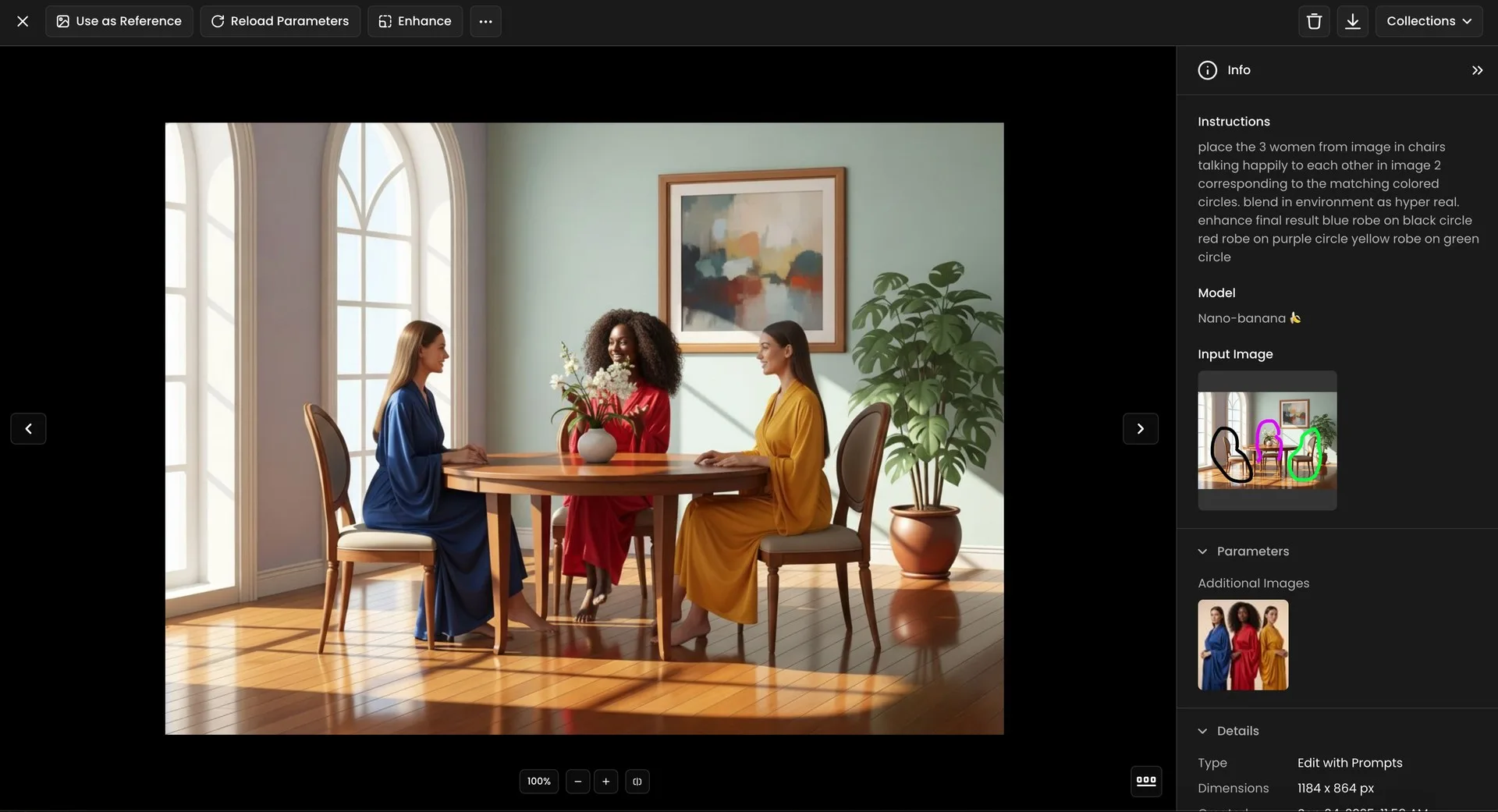
Three women chatting in a bright living room.
26. Sketch to Colored Render
Transform line drawings and sketches into fully realized colored artwork with professional lighting, detailed textures, and dimensional depth that brings flat illustrations to life while preserving the original artistic intent and compositional structure of the source sketch.
Use Case: A black and white line drawing of a fantasy creature is transformed into a full-color 3D render with dramatic lighting and detailed textures.
Prompt: "Colorize this sketch, in a 3D render style"
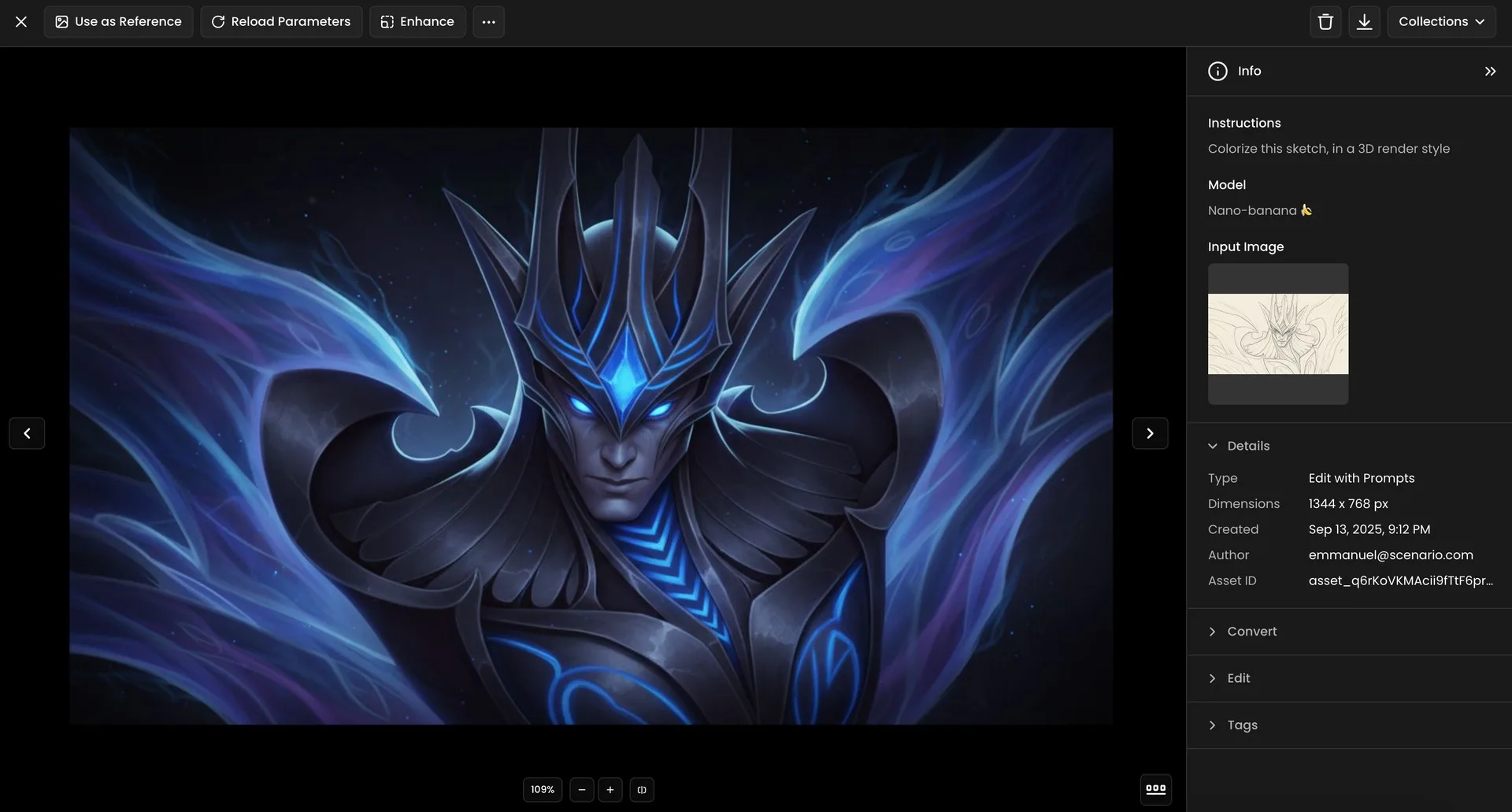
3D render of futuristic armored fantasy warrior.
27. Addition of New Objects into Scenes
Seamlessly integrate new objects, creatures, or elements into existing scenes with proper scale relationships, lighting consistency, environmental interaction, and realistic physics that make additions appear as natural parts of the original composition rather than obvious insertions.
Use Case: A large T-Rex is seamlessly integrated into a forest road scene, running behind a red car with realistic scale and motion blur.
Prompt: "Add a large T-rex running behind the red car on the road"
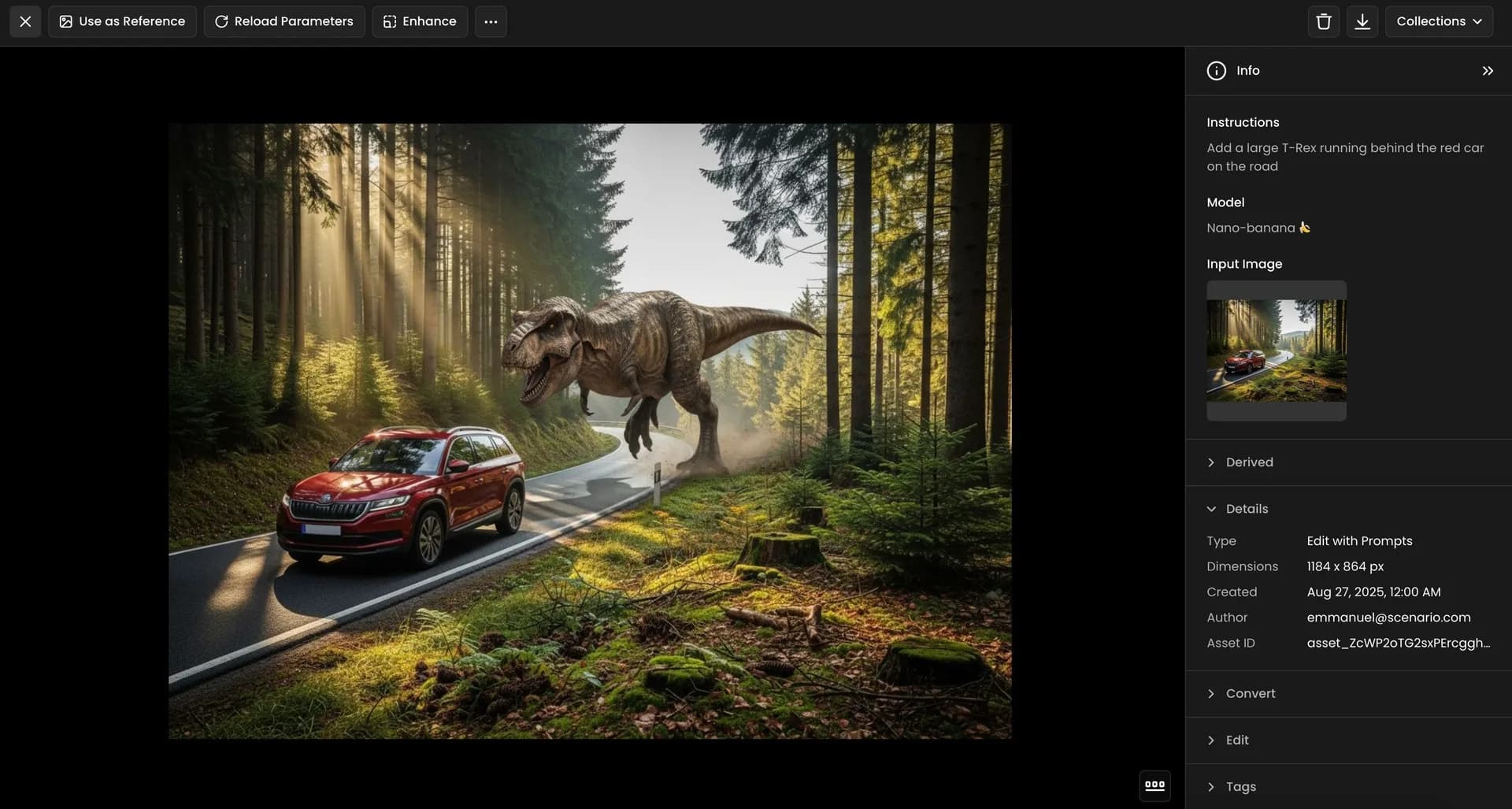
T-Rex chasing car on forest road scene.
28. Character Replacement
Replace one character with a completely different character while maintaining scene composition, lighting consistency, and natural interaction dynamics between remaining elements. This technique involves understanding spatial relationships, scale proportions, and environmental integration to ensure the new character appears as if they were always part of the original scene rather than artificially inserted.
Use Case: A dragon companion is replaced with a green goblin character of similar size, both characters holding game controllers and maintaining the same gaming activity.
Prompt: "replace the dragon by the gobllin. The goblin is as big as the girl, playing video game, holding controller"
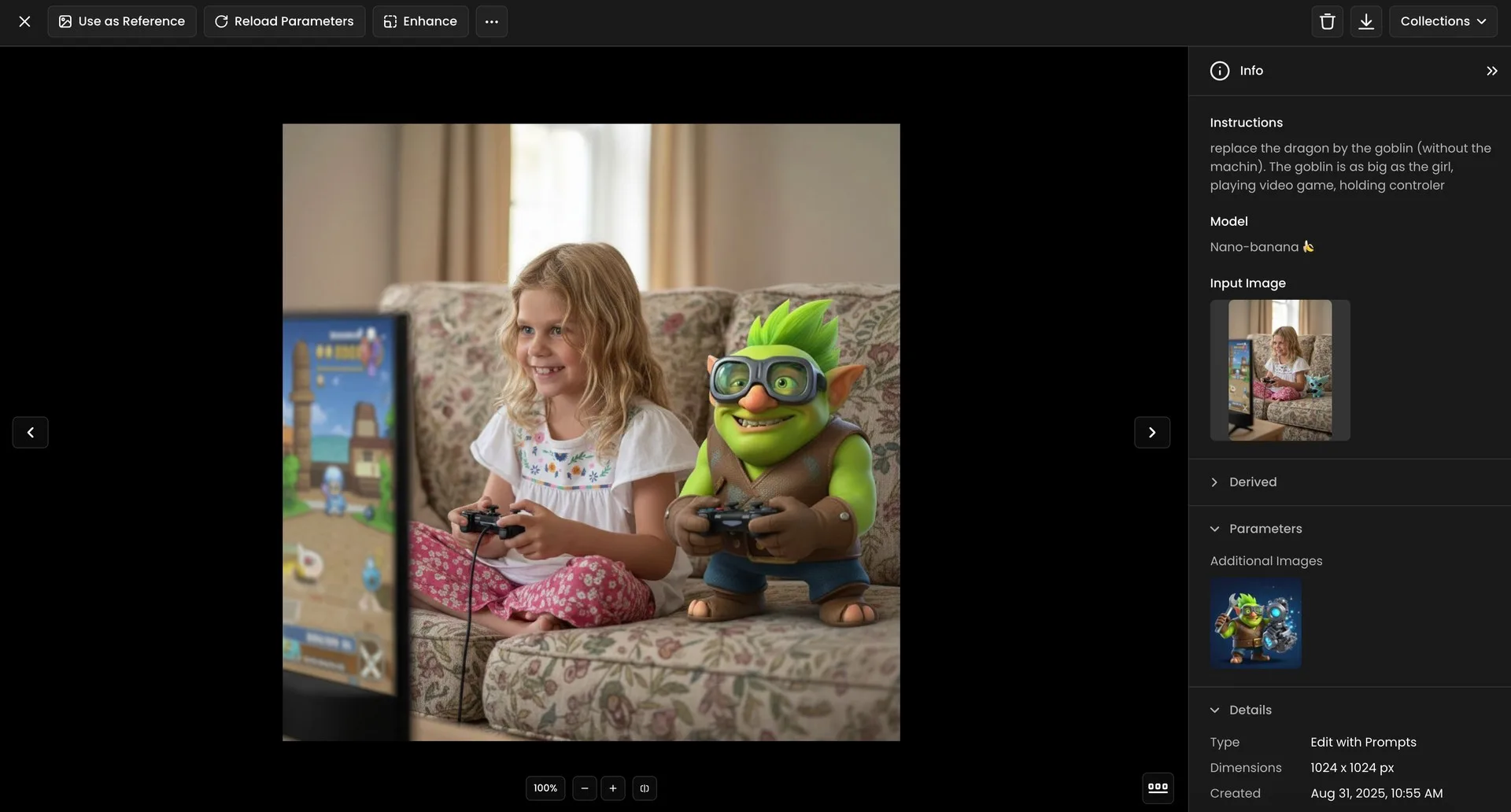
Girl and goblin playing video games on a couch.
Accessing Nano-banana Through Scenario
Scenario offers flexible access options to meet different creative needs:
- Starter: Perfect for individual creators and small teams exploring AI-assisted workflows
- Pro: Designed for creative studios and marketing teams with higher volume requirements
- Max/Enterprise: Tailored solutions for large organizations with custom integration needs
Whether you're an independent creator or managing enterprise-level content production, there's a suitable option for your creative workflow. Get started at https://app.scenario.com/edit-with-prompts
Conclusion: Transforming Creative Workflows with Nano-banana
Nano-banana represents a significant advancement in AI-powered content creation, offering unprecedented control, consistency, and quality for creative professionals. By integrating this technology into your workflow through Scenario's platform, you can dramatically accelerate production timelines while maintaining creative vision and quality standards.
As AI content generation continues to evolve, tools like Nano-banana are redefining what's possible for game developers, marketers, media producers, and creative professionals across industries.
Frequently Asked Questions About Nano-banana
How does Nano-banana compare to other AI image generation tools?
Nano-banana differentiates itself through superior visual consistency across iterations, more intuitive conversational editing, and production-ready output quality specifically optimized for professional creative workflows in gaming, marketing, and media production.
Can Nano-banana integrate with existing creative software?
Yes, through Scenario's platform, Nano-banana can be integrated with popular creative software via APIs and plugins, enabling seamless incorporation into established production pipelines and creative workflows.
What types of creative professionals benefit most from Nano-banana?
Game developers, concept artists, marketing designers, e-commerce teams, and content creators working in film and television production see the most significant workflow improvements, particularly those creating large volumes of visually consistent assets.