ScenarioExplorations Every Scenario

An original song. A 2:05 music video. 24 clips, 1 engine

Every Scenario.

Generated footage.
Code on top.

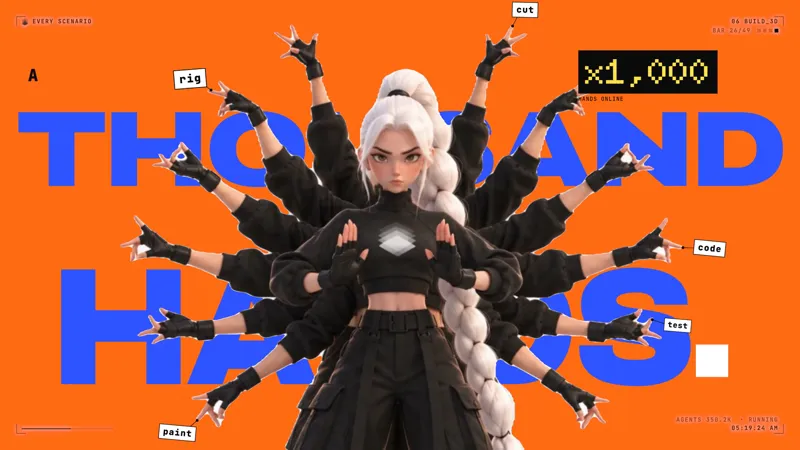
Every shot of her comes from Scenario, untouched. Every word, shape and counter is drawn by code, layered behind and in front of her with a .
Hold F while it plays to peel the code off.

Final LTX 2.5 Pro lip-sync + code layers

0:00 / 2:05

On screen nowClip 01 / 240:00

On screen now

The technique

One frame, five layers.

Footage is never filtered. The engine is : it stacks code around the clean plate, frame by frame, in headless Chrome.

  1. 5
    HUDOvernight clock 02:00 → 07:00, agent counter, sung line
  2. 4
    Graphics in front of herHero words, sparks, frames
  3. 3
    Her, cut out with the person matteApple Vision, run locally on every frame
  4. 2
    Graphics behind herType and shapes that pass behind her body
  5. 1
    Footage plate, cleanThe Scenario clip as generated, no grade, no filter
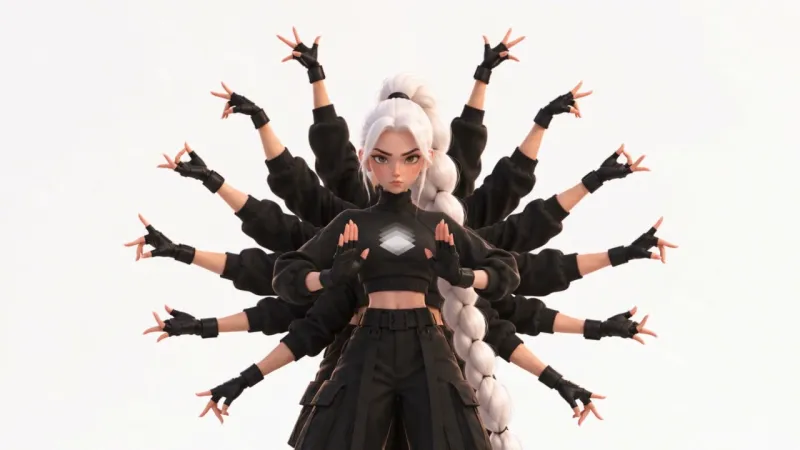
The Seedance clip of the thousand-hands dance on a white set, as generated.
Layer 1 Seedance 2.5 clip, as generated
The same frame in the video: an orange field, THOUSAND HANDS in blue type passing behind her arms, small labels pinned to her hands and a ×1,000 tag.
Layers 1–5 The same frame, 1:05 in the cut

The footage

24 clips. 6,652 credits.

Every generated clip that made the final cut, in order of appearance, with its prompt exactly as it was sent. Image-to-video shots start from a ; dances use .

    From the Scenario job records of this production. Credits are per clip as billed; style frames (13 CU each) and song generations are not included.

    The intermediary assets

    Take the assets.

    The song, the character references and all 24 clips exactly as Scenario generated them, before any code was drawn on top. Each clip ZIP lists the model, credits and prompt of every clip.

    One song, one engine, 24 clips.

    Sara Nemati, creative technologist, directed: the idea, the character, the mood, the references and a verdict on every round. Claude Code wrote the lyrics, ran every model on Scenario through the Scenario MCP, and built the video in code with ten scene agents working in parallel. The brief: a song about “agents that work while you sleep, benchmarks falling, one person with a studio's worth of hands.”

    1. 1

      Write the song, then regenerate, never splice

      11 versions. The MiniMax electroclash take (v4a) became the base; ACE-Step Repaint kept its first 41 seconds and regenerated the rest, then a second Repaint wrote the “Run, check, compile” chant ending. Final: 2:01, about 98 BPM with double-time drums.

      With MiniMax Music 3.0 · ElevenLabs Music v2.5 · ACE-Step 1.5

    2. 2

      Map every beat and every word

      Beats, downbeats, kicks, snares and vocal onsets from the stems; word timings from Whisper large-v3 on the vocal stem. One bar is 2.44 s. These lists drive every cut and every hero word.

      With Demucs stems · faster-whisper large-v3 · Python analysis

    3. 3

      A character sheet, then 17 style frames

      Sara's example images became a character sheet, the reference for every frame, so she stays the same person in 3D cartoon, flat 2D, ink, neon line and pixel art. One style frame per key moment.

      With GPT Image 2.5 · 13 CU per frame

    4. 4

      Animate the frames, drive the dances with beats

      Image-to-video for 14 shots. The four dances used reference mode with a beat track synthesised from the song's own kick and snare map, so every hit lands on its beat.

      With Seedance 2.5 · 186 to 464 CU per clip

    5. 5

      Lip-sync from slices of the vocal

      Six sung close-ups: a style frame plus the exact vocal slice for that line. The engine places each clip at the second its slice was cut from.

      With LTX 2.5 Pro audio-to-video · 124 to 315 CU per clip

    6. 6

      Mattes and pose tracking, locally

      A person matte for every frame of every clip, about 0.1 s per frame, plus 33 pose landmarks. Words can land on her jump; a line can leave her fingertip.

      With Apple Vision · MediaPipe pose · free, on the laptop

    7. 7

      Ten scene agents, one engine

      One designer agent per section, all sharing a style guide, the beat lists and the word timings. Rule: every hero word peaks on its sung syllable, every cut lands on a downbeat. The engine renders 1080p60 in headless Chrome.

      With Claude Code · three.js · Canvas2D · Playwright

    8. 8

      Check, then deliver over the untouched song

      Contact sheets of every scene, an A/V sync check (0 ms), lip-sync and dance-to-beat checks before each version reached Sara. Three endings were built; she picked the pixel-art one.

      With ffmpeg · 6 video versions, 9 full renders

    What did not work

    • Cutting a verse and layering drums onto the finished AI song. “The editing doesn't work.” Regenerating with Repaint did.
    • Asking for a half-time bridge turned the song into a slow ballad. Keep the energy in the prompt.
    • Glow and rotoscope effects on her footage were rejected. The footage now plays clean.
    • Soft mattes looked dirty on pixel art. A hard pixel-grid mask with a one-cell outline fixed it.
    • The logo in gold. It now uses its real grey and white.

    Tip

    Code goes on top of the video, not video on top of code. Keep the footage full-frame and clean, and make the graphics react to her.

    Credits

    6,652 CU

    The 24 generated clips in the final cut, from their Scenario job records. Style frames and song takes are not included.

    Agent skill · ZIP

    kinetic-music-video

    Download the skill

    PDF · Illustrated

    The making-of

    Read the making-of

    Scenario

    Make yours

    Start creating