Body: 78 bones
GPT-6 Astra 3D delivered the rigged body. The final skeleton has 78 bones, with three segments per finger, so the hands can point, grip and spread without losing their shape.
A GAME CHARACTER, BUILT ON SCENARIO
A stylized low-poly character with a complete rig: a body skeleton down to every finger joint, all 52 ARKit face shapes and hair that follows through. Generated and rigged on Scenario through the MCP, then animated with motion pulled from generated video.
THE FILM / 2:06
Body, hands, face, voice and hair, all driven by one rig. The film walks through each layer with narration and captions, shows new moves made from short generated clips, and ends with the same rig talking in Unreal Engine, Unity and Godot.
She walks. She talks. She gestures. A full rig, low poly and baked, made on Scenario.
Every part of her was generated with Meshy, through the Scenario MCP. Then rigged on Scenario. GPT-6 Astra 3D for the body. Claude Opus for the face.
One generated video became her body motion. Seedance made the clip. Viggle turned it into a skeleton. And her feet stay on the ground.
Her hands keep their shape, even when the fingers open wide.
A second generated video gave her face its expressions. The rig carries all fifty-two ARKit blendshape channels.
And when she talks, her lips follow the original audio, frame by frame.
Her face uses the standard ARKit names. So tools like NVIDIA Audio2Face can lip sync her from any voice, even in real time.
Need a new move? Generate a short clip of it. Viggle turns the video into motion, and her rig plays it right away.
And her hair follows through on every turn.
A character you can drop into a game.
LIVE IN YOUR BROWSER
The same character running live: pick an animation and a camera, orbit around her, and switch on the skeleton to see the bones, the hair chains and the jacket hem at work. The walk plays her recorded speech with the sound on.
Loading her rig…
Animation
Camera
Light
View
Drag to orbit. Scroll or pinch to zoom.
STEP 1 / THE PARTS
Meshy 7.1 Image to 3D generated the head, the body, a hand and the watch as separate high-detail models, each from a single image. Generating them apart keeps every part sharp: the face never competes with the boots for detail. They were assembled into one character in Blender.
STEP 2 / THE RIG
Two Scenario 3D models did the rigging. GPT-6 Astra 3D rebuilt the assembled character as a low-poly, rigged body with baked textures. Claude Opus 5.5 3D built the face rig on a new head. Blender added the finishing layers.
GPT-6 Astra 3D delivered the rigged body. The final skeleton has 78 bones, with three segments per finger, so the hands can point, grip and spread without losing their shape.
A new head with slightly parted lips was retopologized with Meshy T2.5 Smart Topology. Claude Opus 5.5 3D rigged it with all 52 ARKit blendshapes, a jaw, teeth and a tongue, under their standard names.
Eight hair bones carry the bob: three chains at the back and the two front tips. A damped follow-through lets the hair lag behind each turn of her head and then settle. Six short chains along the hem of the cropped jacket sway the same way as she moves.
LOW POLY, BAKED
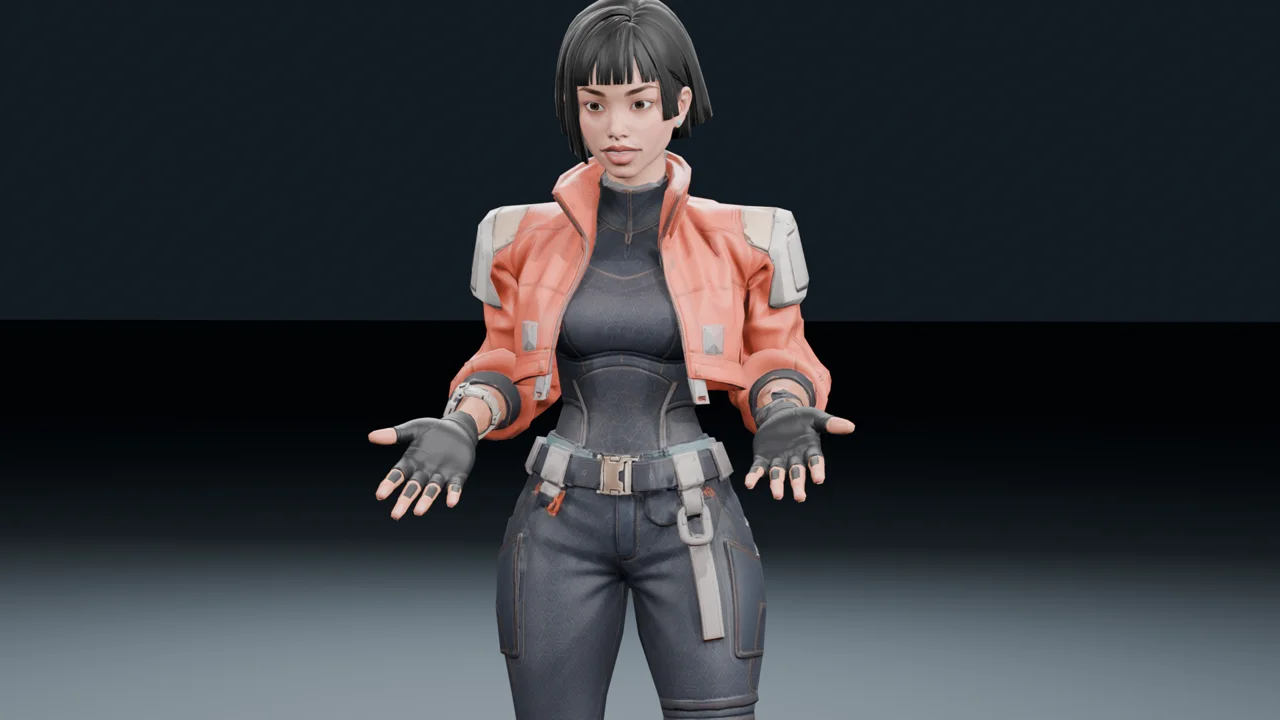
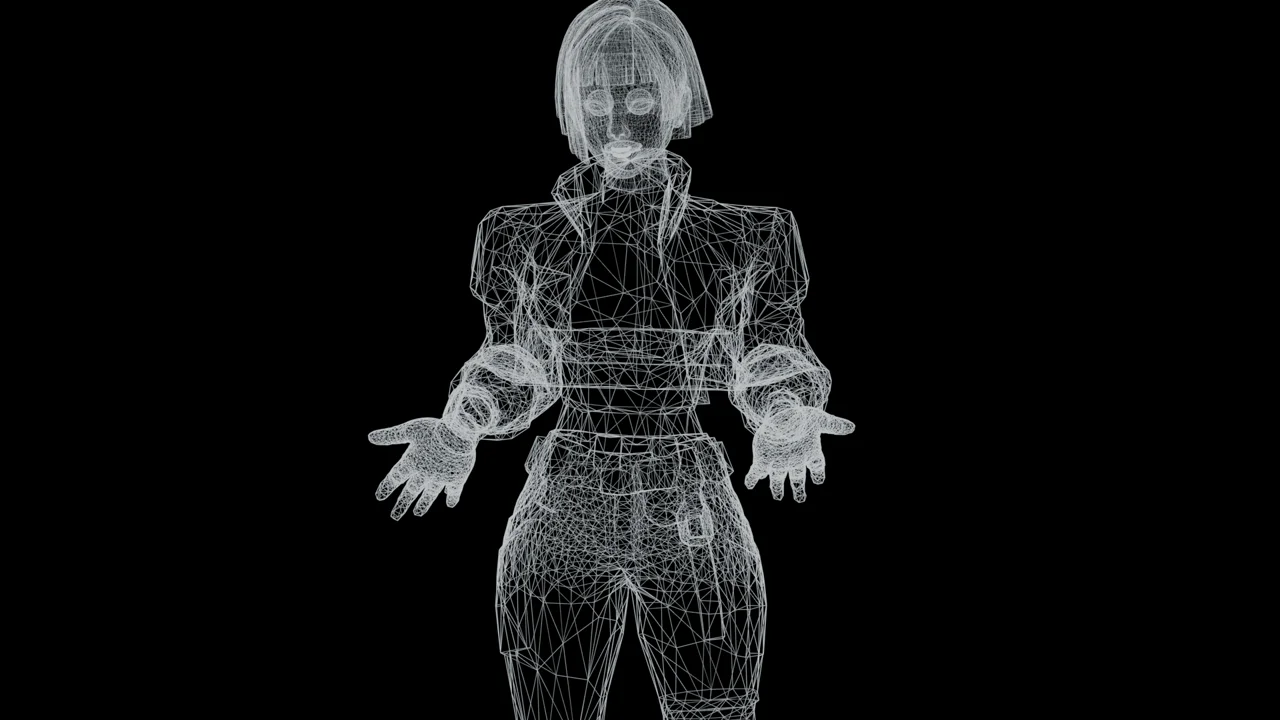
The same frame, textured and as a wireframe. The mesh stays light enough for a game, and the baked PBR textures carry the folds, seams and hair grooves.
STEP 3 / MOTION FROM VIDEO
Seedance 2.5 generates a person performing the move. Viggle Video to Motion 3D turns the clip into a skeleton animation, and that motion is retargeted onto her rig, with her feet kept on the ground. On the left, the generated clip. On the right, her rig playing it.
STEP 4 / SPEECH
Her face expressions came from a second generated video: P-Video Avatar animated a portrait, and MediaPipe read the expressions frame by frame onto her ARKit channels. Because the channels use the standard ARKit names, tools like NVIDIA Audio2Face can drive her lip sync from any voice, even in real time.
STEP 5 / IN ENGINE
The opening walk and talk, rendered natively in Unreal Engine 5.8 (top left), Unity 6000.4 (top right) and Godot 4.7 (bottom left). Unreal and Unity load an FBX export, Godot loads the glTF. The same 90 bones and 52 ARKit blend shapes play the same animation and speech in each engine, and every camera follows the same rule: full body, then her face from 7 seconds.
Godot reads the glTF materials as they are. In Unreal and Unity, the materials were rebuilt from the same Blender maps, because their FBX imports leave out the roughness and metal maps. Lighting was matched by eye.
WHO DID WHAT