
Scenario/ Explorations Create yours

Plays the six stages in order with narration and captions, from stage 1 to 6.

Inside a Heartbeat

Follow the blood through one beat.

A teaching model of one heartbeat, made with Scenario.

  • For medical educators, museums and health learning apps.
  • What. One heartbeat in six narrated stages and four layers, drawn as 48 medical plates on a teaching model checked against open textbooks.
  • Scenario. Through the Scenario MCP, an agent made the plates, the tissue maps and the voices. Every arrow and signal is drawn from the model.
Explore the heart
Plate 3 of 6Ventricular ejection, cut through the four chambers. Oxygen-poorOxygen-rich

6 stages · 4 layers · 2 overlays · 48 platesBegin at stage 1

One beat, six stages.

Press Play the beat to watch one heartbeat, or pick a stage.

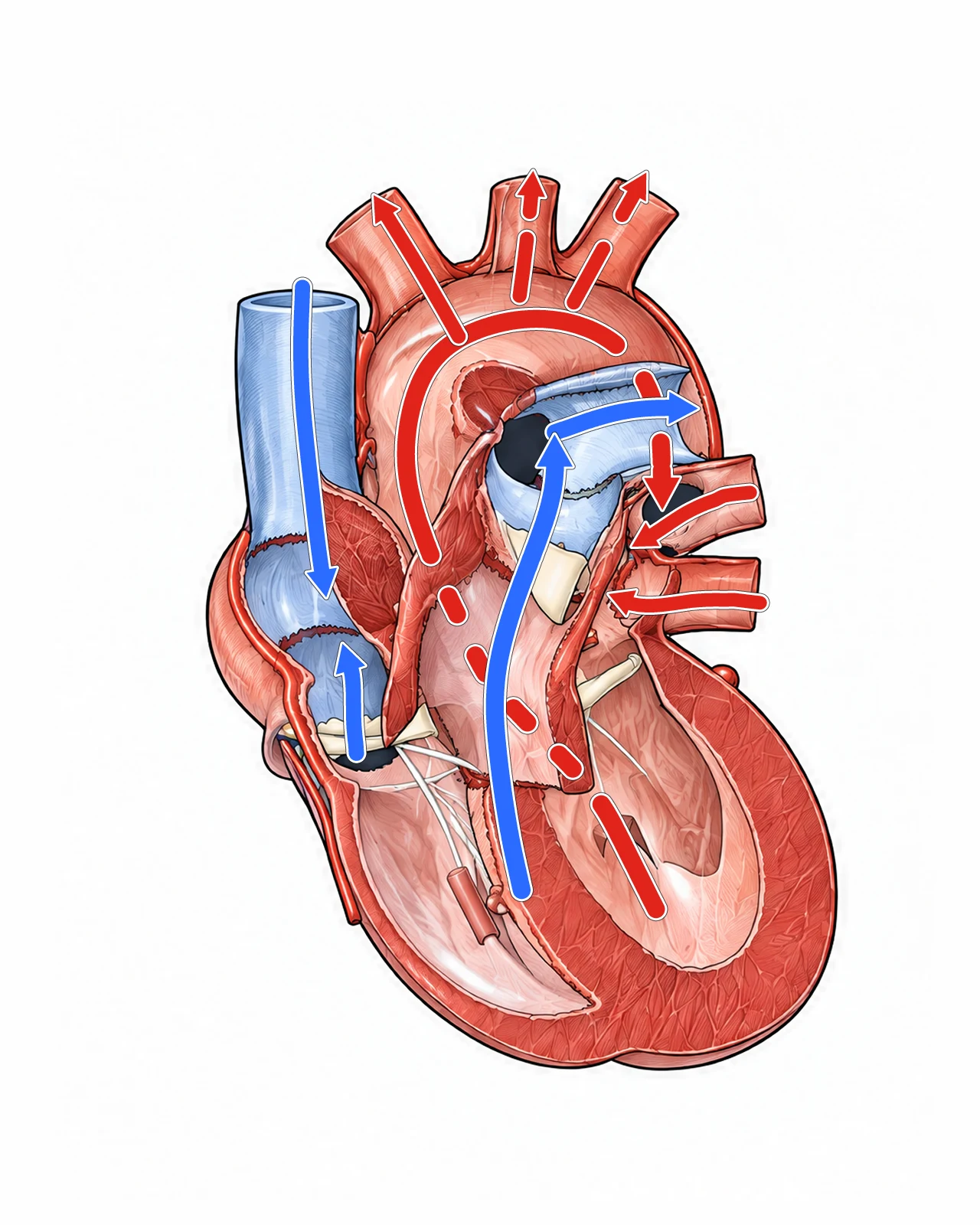
Stage 1, atrial systole: medical plate of the see-through layer with the blood flow overlay
Oxygen-poorOxygen-richteaching colours; thicker is faster

Stage 1 of 6The atria squeeze blood into the ventriclesAtrial systole · ECG: P wave

What you see

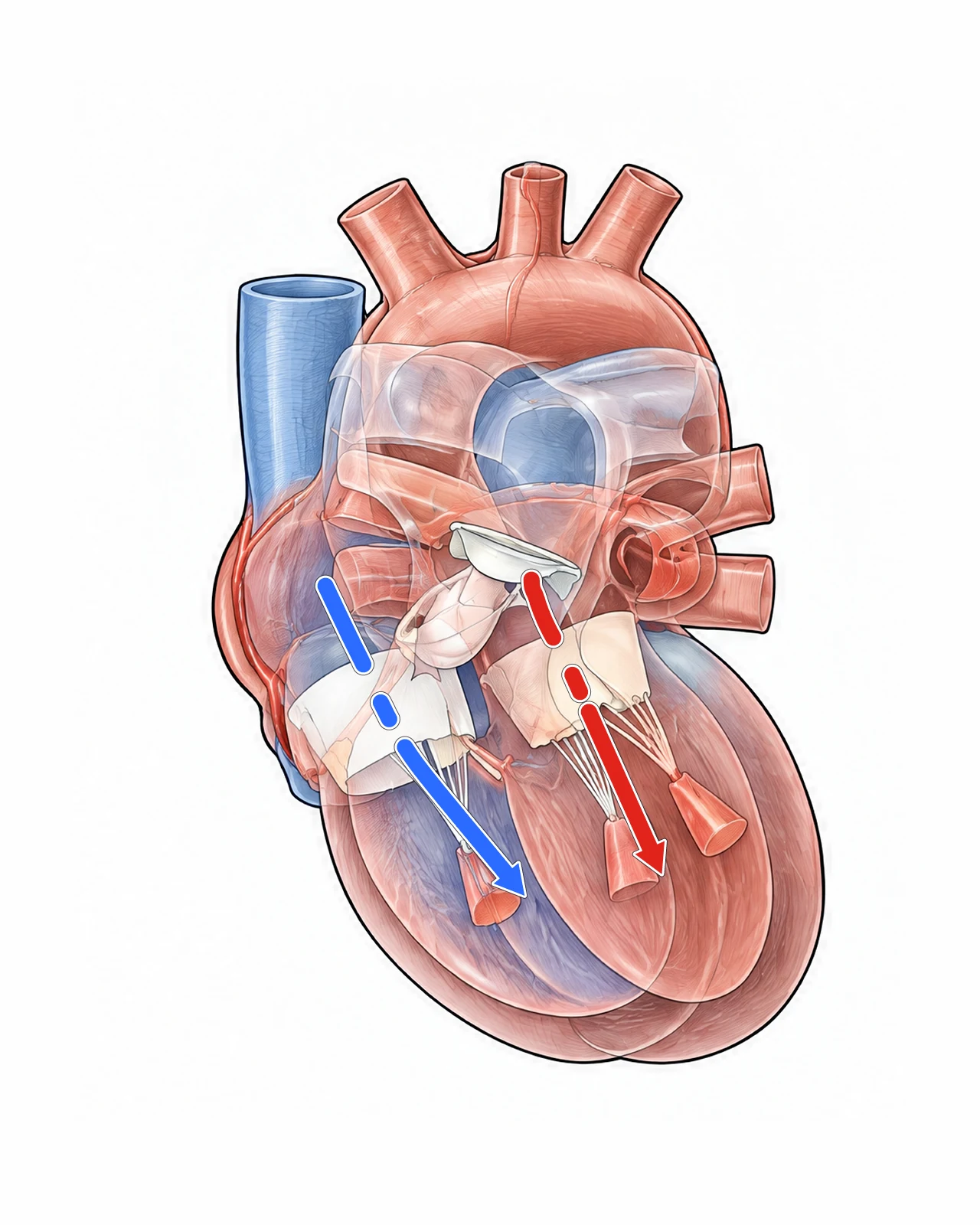
See-through: the walls made clear, with the valves and signal path inside. Blood flow: blue is oxygen-poor, red oxygen-rich.

More ways to see it: The plate is drawn by GPT Image 2.5 Sunburst over the model's render; the arrows and the signal come from the model.
Tricuspid
open
Mitral
open
Pulmonary
closed
Aortic
closed

Flow. The atria contract and push the last 20 to 30 percent of filling into the ventricles.

Signal. The SA node fires. The wave spreads across both atria (internodal pathways, Bachmann's bundle to the left atrium) and reaches the AV node, where it is held for about 100 ms.

Atria contract; the ventricles reach their largest volume.

What the narration says

Stage one. A signal starts in the sinoatrial node, high in the right atrium, and spreads across both atria. They contract and push the last part of the filling into the ventricles.

Sources: OpenStax 19.2 (opens in a new tab) · OpenStax 19.3 (opens in a new tab) · Wiggers diagram (Wikipedia) (opens in a new tab) · NIH NHLBI (opens in a new tab)
See-through: The wall made transparent: blood volumes, the four valves and the conduction path inside. Blood flow: Blue marks oxygen-poor blood and red oxygen-rich blood, a teaching convention (blood is red on both sides). Thicker arrows mean faster flow; a dashed stretch passes behind tissue.

With the heart focused: ← → stage, L layer, O overlay, K names, N listen, P play the beat.

Made along the path of the blood.

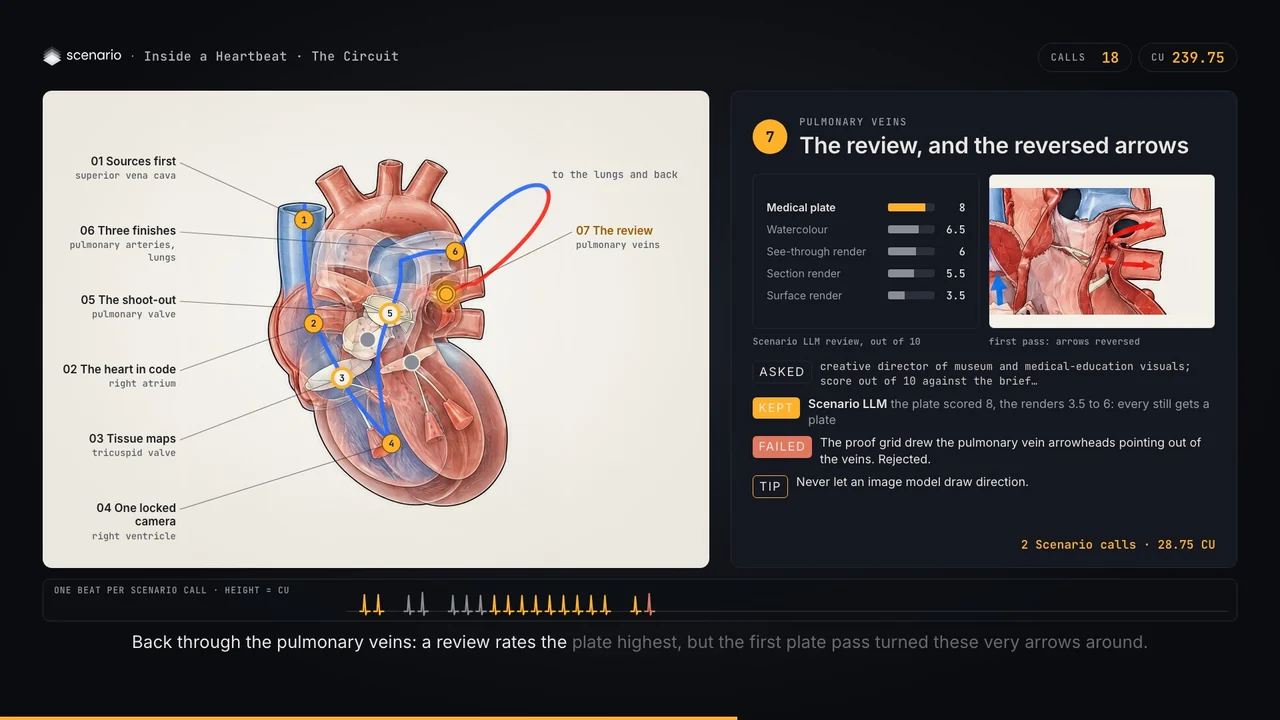
The film follows one beat through the heart: every stop is a step of the build, every valve a check. Sources first, one heart model in code, one locked camera, plates drawn over the renders, and the model's own arrows on top.

53 Scenario calls · 9 models · 541.75 CU, from the ledger

Watch how it was made 1:56Read the steps

Take the beat with you.

You followed one heartbeat from atrial systole to diastasis. The skill lets your agent build the same kind of staged explainer with the Scenario MCP.

  1. Skill · ZIP, 9 KB

    Make your own explainer

    Your agent builds an accurate staged explainer (a heartbeat, a breath, a machine cycle) with the Scenario MCP. Unzip the scenario-anatomy-explainer folder into your agent's skills folder.

    Download the skill
  2. Making-of · PDF, 12 pages

    How it was made, on paper

    Sources, the model in code, the plates, the review and the voices, step by step.

    Open the PDF (opens in a new tab)
  3. Film · 1:56, captions

    The Circuit

    The build told along the path of the blood: every stop a step, every valve a check.

    Watch the film
  4. Recipe · ZIP, 22 KB

    Every prompt and model

    Every prompt as sent, every model with its calls and CU, and the page's data.

    Download the recipe
  5. 3D heart · GLB, 1.9 MB

    The heart model

    Stage 3, surface layer, with vertex colours, for 3D tools that open GLB files.

    Download the GLB

A teaching model of a typical adult heart, checked against the cited open textbooks, for learning how a heartbeat works. It is not medical advice and uses no patient data.

Create yours