
Every Character You Have Ever Made Can Now Speak. Meet P-Video 2 Pro Avatar.
A flamenco dancer. A marble Roman bust. A cartoon pineapple chef. An anime girl. A news anchor. P-Video 2 Pro Avatar turns any of them into a talking video with accurate lip sync. Here is how it works and what it can do.
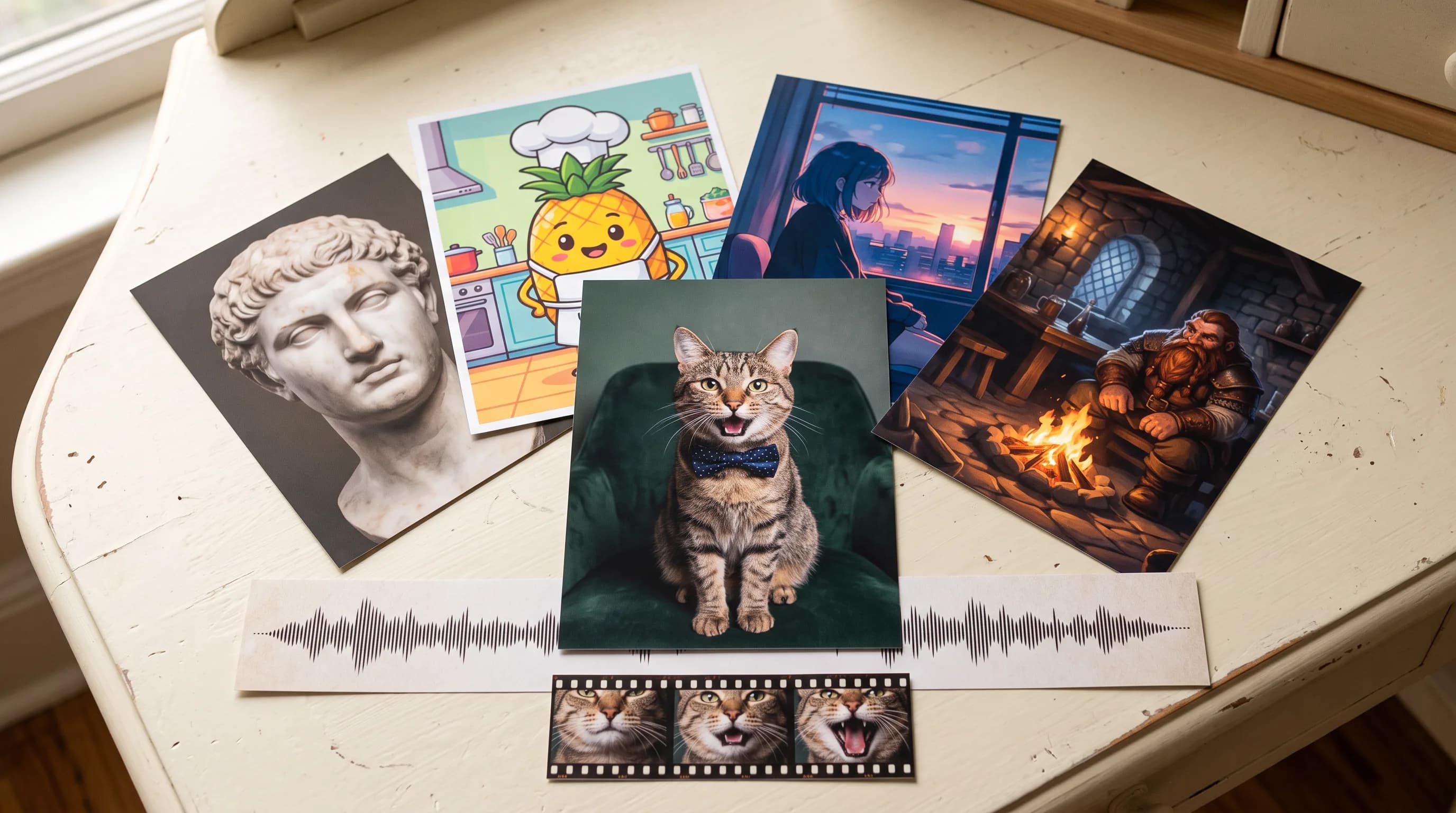
The range of what counts as a character is wider than most talking avatar tools are built for.
A photorealistic portrait of a woman in a flamenco dress. A marble Roman bust. A cat in a bow tie sitting in a velvet armchair. A cartoon pineapple with a chef’s hat. An anime girl by a window at sunset. A NASA astronaut at an ISS porthole. A grandmother kneading dough. A fantasy dwarf by a fire. Marie Antoinette from an 18th-century oil painting.
P-Video 2 Pro Avatar by Pruna AI handles all of them. Upload the portrait. Provide the audio. Get back a video of that character speaking, with accurate lip sync matched to the words.
Here is what it does and how to get the best results from it.
What It Actually Does
P-Video 2 Pro Avatar drives a still image to speak from an audio input. The output is a video of the character performing the speech with mouth movement synchronized to the audio, facial motion that feels natural, and a head that moves the way a person moves when they talk.
It works across a remarkably wide range of subject types. Photorealistic people in any style: photojournalism, cinema, studio portrait, lifestyle. Illustrated and stylized characters: anime, cartoon, flat design. Non-human characters: a talking cat, a frog at a microphone, a pineapple chef, a marble bust. 3D renders. Historical paintings. Game assets and NPCs. If there is a face in the image, P-Video 2 Pro Avatar can drive it.
The lip sync quality is the thing that separates this from earlier generation avatar tools. The mouth does not just open and close in rough time with the audio. The shapes match the phonemes. When the character says a word with tight vowels the mouth reflects that. When there is a pause the face settles naturally rather than holding a frozen expression.
The Input
Two inputs: a portrait and something for the character to say.
For the portrait, upload anything with a clear face. Photorealistic, illustrated, cartoon, 3D render, historical painting. If there is a face in it, it works.
For the audio, two paths. Type the script directly into the Voice Script field and choose a voice and language from Settings: the model generates the speech for you. Or upload your own audio file if you already have a recording or something generated by another model on Scenario.
An optional Prompt shapes the expression and delivery. A Voice Prompt steers the tone when you are using Voice Script. Neither is required but both are worth using when the performance matters.
What You Can Do With It
NPCs and Dialogue
A character concept with a voice line is one of the most common production tasks in game development. Generate the character portrait with any image model on Scenario, generate the voice line with a TTS model, feed both into P-Video 2 Pro Avatar. The NPC speaks.
It works across every character type: a cartoon dwarf innkeeper greeting the player, a cartoon pineapple chef explaining a recipe mechanic, a fantasy scholar narrating a quest, an anime protagonist reacting to a story beat. Cartoon, stylized, realistic, illustrated. Every archetype, every art style.
Social and marketing content
A spokesperson who exists only as an image can now deliver a message on camera. An illustrated brand mascot can speak directly to an audience. A historical figure can narrate an educational piece. A product character can introduce a feature. The character does not have to be a real person to appear in video content.
Localization
Record the same script in multiple languages, run each audio track through P-Video 2 Pro Avatar with the same portrait, and the same character speaks the localized version with lip sync matched to each language. One character, multiple markets, no re-shoots.
Bringing static art to life
The Marie Antoinette portrait, the marble Roman bust, the cat in the velvet armchair: these are not game assets or marketing characters. They are demonstrations of what the model does when you give it a still image that was never meant to speak. Historical portraits, paintings, illustrations, photographs: P-Video 2 Pro Avatar drives them all.
A Few Things to Know
The model works best with clear frontal or near-frontal faces. Severe profile angles, heavy occlusion, or very small faces in a wide scene produce less stable results.
The audio quality matters. Clear articulation and minimal background noise produce the cleanest lip sync. Heavily compressed or noisy audio degrades the mouth movement accuracy.
The optional prompt is worth using when expression matters. A news anchor delivering breaking news needs a different register than a grandmother explaining a recipe. The prompt is where you set that.
Try P-Video 2 Pro Avatar on Scenario
FAQ
What kind of images does it work with?
Any image with a clear, visible face. Photorealistic portraits, anime, cartoon, illustrated characters, 3D renders, historical paintings, non-human characters. The face should be frontal or close to frontal and not heavily occluded.
What audio formats does it accept?
Standard audio files. Generate audio directly on Scenario using any TTS or voice model, record in-browser, or upload a file.
Does the lip sync work across languages?
Yes. The lip sync tracks the audio regardless of language. Run the same portrait with different language audio tracks for localized versions.
How is this different from the original P-Video Avatar?
P-Video 2 Pro Avatar is built on H3 and produces higher-quality lip sync and more natural facial motion, particularly across non-photorealistic character types.
Can I use it for non-human characters?
Yes. The model drives any face in the image including illustrated animals, cartoon characters, stylized mascots, and fantasy creatures.