From Months to Weeks: How Future Run Automated Asset Production with Scenario
Future Run's creative director built a tool on Scenario that takes a rough drawing and a few references through to finished 3D assets in Unity, with the steps in between automated.
Overnight
Prop Batches
Next day
Full Game Reskin
Months to weeks
Animation Production
About Future Run
Future Run (ftr.run) is a video game studio based in Tampere, Finland. It was founded in 2023 by former developers from Traplight, Rovio, Supercell and Remedy, and has been backed by Supercell across two funding rounds.
The challenge
The studio is prototyping several games, and the art behind them spans concepts, environment props, characters, 3D models, textures and rigs.
Sami knows how much work traditional production takes. A single short 3D animation once took him nine months from script to finish. He made most of the art himself, from background paintings and character designs to character models, texturing, shading and rendering, and he describes the production as nightmarish.
He learned those skills because he was passionate about animation, and he says getting them is a long path.
The approach
The work began with Scenario's own tools. Then Sami realized he could go further and build his own. The result is an asset tool he vibe coded himself, with Scenario as its generation layer.
The tool takes his drawing and references, writes the prompts, sends each request to Scenario, and carries the results through Blender and into Unity. In his words, "all this comes from Scenario." He keeps working on the tool every day, adapting it as new features arrive.
Scenario works, as Sami puts it, as a portal to hundreds of models. As an artist, he can take whichever one he wants for a test and create several different concepts for the same 3D model. That freedom is a big part of how he works: he experiments a lot, and all of it runs through Scenario.
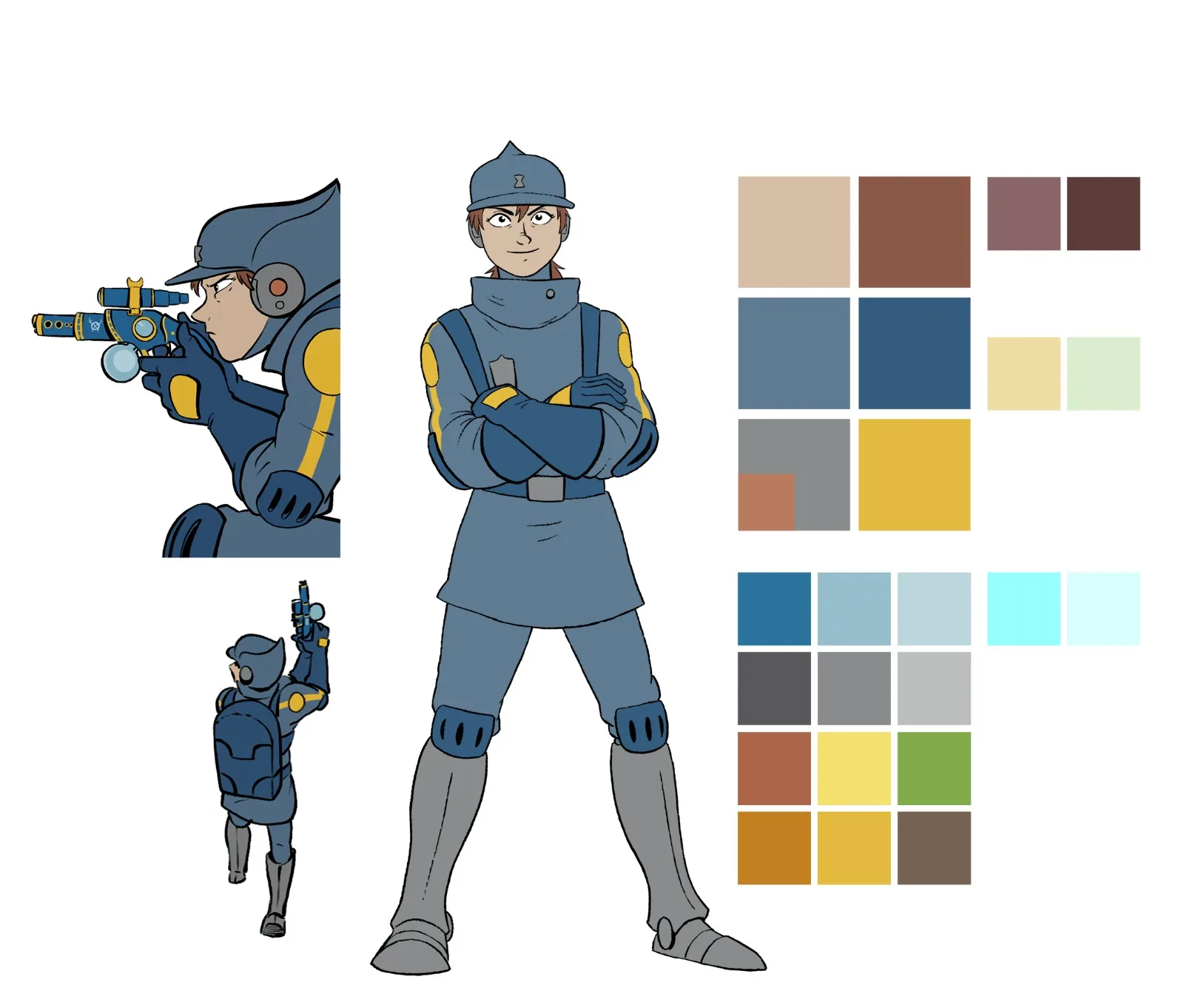
The process can start from a rough drawing. "You can just draw really roughly and then create this unique look," Sami says. The references he adds set the colour palette and shape language, and Scenario turns it around fast, so he can already see the production quality he is aiming for.
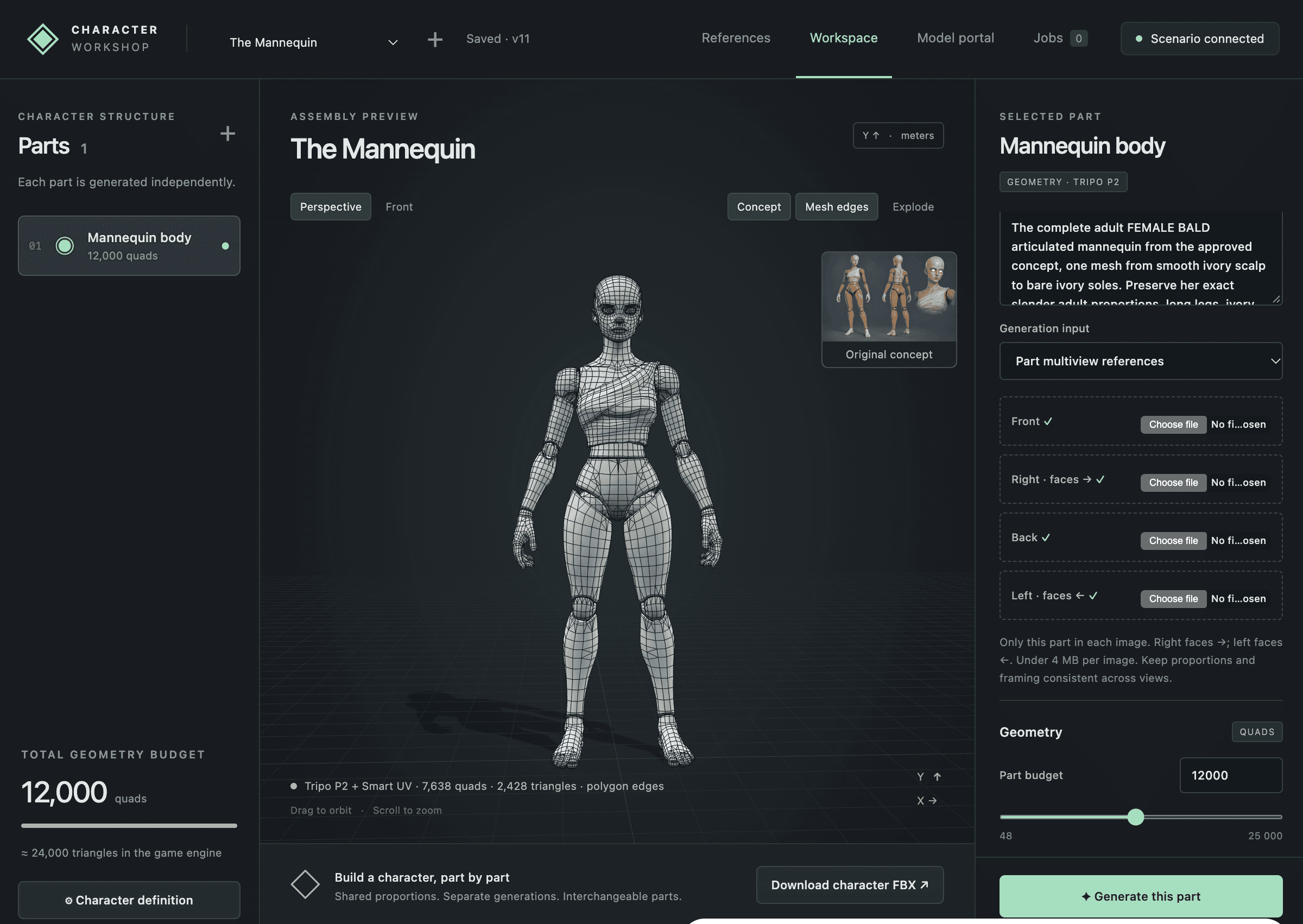
Scenario generates the concept, and the tool turns it into a reference sheet for the asset. Based on that sheet, the tool opens Blender and creates the 3D model, using Rodin or Tripo.
Sami has Astra review every single model against its concept, iterating until it looks like the concept. Roughness and metallic maps are generated for the metal and leather parts and packed for Unity URP.
Once the asset is in Unity, the humanoid setup and rig are done automatically.
What it makes possible
Overnight production. For a first-person horror prototype set in an eighties high school, Sami ran overnight batches of environment props: sofas, tables, overhead projectors, TVs and cassette boxes.
A new theme in a day. For another test, Sami created a traditional fantasy city builder. He gave the tool a few reference images, and the next day, when he opened his computer, it had reskinned the whole game with a mafia-themed Las Vegas look.
Constant experimentation. Between testing models, exploring concepts, running overnight batches and reskinning whole games, Sami uses Scenario heavily, and the studio goes through its credits fast. He doesn't see that as a problem. It's a sign of how much the pipeline now does: "Our pipeline now is just crazy."
A tool that keeps improving. Recurring settings, such as transparent backgrounds, are written into the tool's prompts once rather than ticked for every generation. The tool also moves fast: a masking step Sami built to clean up reference sheets was no longer needed within a few weeks. "It just evolves every day," he says.
What they used
- Scenario as the generation layer, with access to hundreds of models for concept work
- Rodin and Tripo for 3D generation
- Astra to review each model against its concept
- Blender for creating the models
- Unity URP as the destination, with automatic rigging
The result
Looking back at the animation that once took him nine months, Sami believes that with these tools, "you can squeeze that into some weeks."
Sami has also tested Scenario outside the studio's own games. A friend of his has been developing an animated world for more than ten years, and Sami offered to see what these tools could do with it.
From a few of his friend's character drawings, he built a character sheet, spent a couple of days on the script and used Scenario to produce short clips of the characters together. The quality, he says, was amazin
At a glance
Scenario at the core of the pipeline.
- Hundreds of models on one platform. Scenario gives the studio access to hundreds of models, so the right one can be picked for each test and a single asset explored in several directions.
- Works seamlessly with custom tools. Scenario plugs into the tool Sami built, which writes the prompts, sends the requests and carries each asset through to a rigged character in Unity.
- Production quality, early. From a rough drawing and a few references, Scenario lets the team see the quality they are aiming for fast, with props generated in overnight batches and a whole game reskinned by the next day.
- Scenario in heavy use. Sami experiments constantly, and so much now runs through Scenario that the studio's "burning credits".
An artist's view
Sami is open about having mixed feelings. He calls AI a two-sided sword. As an artist, he feels it can take away the joy of animating by hand, where every move and pose is yours to control.
But he also sees it as part of the future: it already helps production pipelines, and it gives indie creators a way to pitch a bigger vision to investors and studios.
When he first tried it, he says, it felt like the first time he opened a 3D program, confusing at first. Now he sees it as a way to take his skills to the next level and keep his imagination rolling. "That's scary," he says, "but also super exciting."
The future of game development and movie VFX is that you create your own different tools. You don't need to do similar things that every other studio is using.
Sami Timonen - Creative Director, Future Run
Why Scenario
Built to build on. Sami started with Scenario's own tools, then built a custom tool on top of it, with Scenario as the generation layer behind the whole pipeline.
Hundreds of models in one place. Scenario works as a portal to hundreds of models, so he can test whichever fits and explore several concepts for the same asset.
Works seamlessly with custom tools. The tool sends each request to Scenario and writes the prompts itself. In Sami's words, it "works seamlessly" with what he has built.
Production quality, fast. From a rough drawing and a few references, Scenario lets him see the production quality he is aiming for early on.
Looking ahead
Sami's tool evolves every day, and he already has ideas for what to build next. For him, that's the direction game development and film VFX are heading: studios creating their own tools for each project, with the freedom to build exactly what they need.
As new models and features arrive on Scenario, he folds them into the tool, so it keeps growing with the platform. "Every day a new adventure," he says.
 ×